Showing posts with label History. Show all posts

Friday, December 24, 2021

Apollo 8: Christmas Message Orbiting the Moon

Apollo 8' astronaut Frank Borman's Christmas Eve Prayer
 Three NASA astronauts circled the Moon in December 1968 on a mission to prepare for the first human landing on the Moon the next year. 


When transmitting to Mission Control in Houston, Frank Borman and the crew of Apollo 8  gave a Christmas Eve prayer which might scandalize avowed atheists or today's adherents to the creed of political correctness.


[This piece was originally posted on DCLausDeo.US]

The Story of NORAD and the Santa Tracker


A family tradition in my youth was worshiping at a Vigil Mass on Christmas Eve and driving around nearby neighborhoods with wonderful holiday light displays while listening for NORAD reports on Santa Claus' whereabouts.  As a jaded grown-up, I presumed that these reports were performance shtick on a long media night.  Little did I know that the reports were real and that a typo and the good cheer of an Air Force colonel brought joy to the world.

During the 1950s, America was engaged in a Cold War with the Soviet Union which threatened to become hot at any moment. School children of the era was raised to be prepared to duck and cover at any given moment due to a sneak nuclear attack from the enemy.  Soon, Sputnik's successful launch made watching the skies even more important.

In Colorado Springs,Colorado at  the Continental Air Defense Command    a.k.a. CONAD (the predecessor to the North American Aerospace Defense Command or NORAD), there was a red telephone on the commander's desk which had a secret telephone number known only by a four star General at the Pentagon, which would have been used to convey news of an enemy aerial attack.

However, in December 1955, the CONAD commander's red phone rang and the voice on the other line was a little voice which asked "Is this really Santa Claus".  At first the Colonel was upset at what he thought was a crank call, but when he heard crying, the straight laced Colonel changed his demeanor.  The CONAD commander ho-ho-hoed and asked the caller if he had been a good boy.  Afterwards, the Santa Colonel asked to speak to his mother.

It seems that a copy for a Sears Roebuck newspaper ad had a misprint, so "Santa's private phone" number not connecting to Toyland but was actually the secret military number for what is now NORAD. Colonel Shoup delegated a few airman to act like Santa Claus for kiddie red phone callers.


Col. Shoup's daughter,  Terri Van Keuren, recounted: "It got to be a big joke at the command center. You know, 'The old man's really flipped his lid this time. We're answering Santa calls".  So much so, on Christmas Eve 1955, airmen modified the big glass board used to track air flights and included a drawing of a sleigh and eight reindeer coming from the North Pole.

When Col. Shoup saw this modified big board, he exclaimed: "What is this?".  His subordinates apologized and insisted that they were just making a a joke.  Shoup pondered the predicament for a bit and then telephoned a radio station with the message: "This is the Commander at the Combat Air Center, and we have an unidentified flying object.  Why, it looks like a sled.".  Hence the tradition began.

Now kids can call 1-877 HI-NORAD (1-877-446-6723) to talk to NORAD staff about Santa's exact location.  The internet tracker for the big man in red began in 1998 with the SantaCam.  At noradsanta.org, people can view the SantaCams from around the world as well as understand NORAD's main mission. Last year, "Operation Feel" had F-18 fighter jets escorting Santa and his sleigh, which led CNN reporters questioning if the US military had taken possession of Santa Claus.  Of course, these reporters failed to report on "Operation Noble Eagle" with the Royal Canadian Air Force escorts over their territory or how these videos infuse some of NORAD's primary mission to girls and boys along with the spirit of the season.


Colonel Shoup died in 2009.  But even in his 90s, Shoup proudly carried a briefcase which he treated like had top secret information that contained letters thanking him for having a good sense of humor in allowing NORAD to track Santa.


h/t: NPR
      NORADSanta.org 

[This piece was originally published on DCBarroco.blogspot.com]

Friday, February 12, 2021

Remembering Lincoln's Birthday


 On the 212th anniversary of his birth, here is a re-enactment of Abraham Lincoln's brief Second Inaugural Address, delivered on March 4th, 1865, less than six weeks before he was felled by an assassin's bullet.


If only blue and grey partisans had taken Lincoln's words urging reconciliation to heart.  Instead we had twenty years of antagonistic Reconstruction and nearly a century of  Jim Crow laws.

These noble words are poignant today for real efforts of national unity. 

Monday, December 14, 2020

"Biden Did You Know?"--An Advent of Truth?


For many Christians, Advent is a a time anticipation for our ultimate salvation via the incarnation of our Messiah Jesus the Christ.  To get to that point, the faithful are asked to prepare by contemplating the end times and final judgment.  That is why the liturgical readings are prophetical and often tinged with a sense of calamity. This preparation exposes hard ultimate truth and raises questions as to how we comport ourselves in the here and now.

In our culture we prefer the unbridled joy of Christmas Carols rather than the brooding meditations of Advent hymns, like "Wake, Oh Wake" and "Veni Emmanuel".  One of the new contributions to the Advent repertoire is "Mary Did You Know?",  a Protestant carol written by Mark Lowry 1984 and later set to music in 1991 by Buddy Green of the Gaither Vocal Band.   The lyric were written as reflections between acts of a Christmas play which posed hard questions as to whether the Blessed Virgin Mary understood everything that would be implicated by her fiat, her assent to what God asked for in the Annunciation. 

In the wake of the instances of election irregularities and accusations of coordinated voter fraud in Election 2020,  Eric Metaxas did a a filk written by by John Zimrak  and produced by Chris Hines of the contemporary Christmas-tide classic in "Biden Did You Know?


This video could be dismissed as a piece of propaganda from a Trump supporter blowing off steam at the victory of his opponent former Vice President Joe Biden (D-DE).  More sympathetic listeners might find it hard to hear as Mr. Metaxas is not a natural soloist.  But the video raises some uncomfortable questions that the presumed President Elect must address as nearly half of Americans are under the impression that Election 2020 was stolen. Metaxas combined pop cultural film references, graphics which illustrated his points along with video evidence indicated election night Malarkey (sic), such as the Fulton County Georgia suitcase of hidden ballots, the Detroit TCF Cobo Center  hidden vote count center and CNN's chyron of over a hundred thousand ballots instantly switching columns. 

Even though Election 2020 was conducted during the COVID19 pandemic, the Biden presidential campaign was conducted in an extremely unorthodox fashion.  During the General Election campaign, Biden basically hid in his basement with a message of  defeating Trump and COVID19  using a wholesale campaign strategy. Biden ads ran heavily, along with allies like the Lincoln Project.  Other campaign events included poorly attended Zoom calls and scripted "interviews" with friendly media (and Biden reading off a teleprompter or being corrected by his wife DOCTOR Jill Biden--sic).    


During the normally intense two months before the November 3rd vote, the Biden campaign called "lids" (no news today) at nine am for a fortnight. Biden's running mate, Senator Kamala Harris (D-CA) did not try to outshine the top of the ticket on the hustings.  When Joe Biden deigned to be seen in public, he mostly appeared in Delaware or within even driving distance of Philadelphia.  Such "rallies" were more media events, with basely a score of attendings sitting in COVID correct socially distanced circles. 


By the end of the General Election campaign, Trump counter-protesters were overshadowing the curated Biden/Harris campaign events, so much so that Joe Biden, the candidate calling for unity, called them
chumps and ugly folks.  Harris held "rallies" in secret locations and may have employed body doubles at events. These do not seem like tactics of a campaign which supposedly won 80 million votes, 10 million more than President Barack Obama. 

 This Biden/Harris unorthodox campaign conduct sharply contrasted with President Trump, who help scores of rallies which attracted  tens of thousands of attendees per event, many unruly off the cuff pressers.  Donald Trump definitely won 10 million votes more than 2016, with marked increases of support from African American and Hispanic voters.  Trump had coat tails, with Republicans winning 27 of 27 key House races and the GOP only losing two Senate seats when they had 23 races to defend.  Trump won 18 of 19 bellwether counties.  Yet supposedly Trump lost by six million Popular Votes and lost several battleground states by small margins bolstered by midnight ballot drops thusJoe Biden wins 306 Electoral Votes.  In the abstract, that doesn't make sense, but these facts may be derided as  sour grapes.

In retrospect, there were several odd remarks from Democrats about the Biden campaign the post election aftermath that when they are juxtaposed with the election anomalies that give a skeptical body politic cause for pause as to "Biden did you know?".

One of Joe Biden's persistent traits is being a gaffe maker  So often, his off the cuff remarks seem blunderously off-message,  wrongfully boastful,  and actually quite odd (e.g. "Corn Pop").  I was willing to consider those moments as being the Biden gaffe machine, which has been heighted due to obvious cognitive challenges and overplaying his "aw-shucks Uncle Joe" persona.  But sometimes these gaffes reveal uncomfortable truths, albeit in a clumsy manner.  A pithy maxim in the District of Calamity is that a gaffe is a politician telling the truth.  Joe Biden has said: "A gaffe in Washington is someone telling the truth and telling the truth has never hurt me."  OK, let's test that premise.

One of the most striking verbal blunders was when Joe Biden actually said that [Democrats] had put together the biggest and most extensive voter fraud organization in history. Wow, what a gaffe!


Perhaps he meant to say "Get Out the Vote" organization.  But let's examine this gaffe with the facts.  In the 116th Congress of 2019, Speaker Nancy Pelosi put forth HR1, which was a measure that sought to imposes mail in voting nationwide. Note this was a year BEFORE the Wuhan Flu reached the shores of America.  When that measure did not pass, a couple of COVID relief bills were held up in reconciliation bills because Speaker Pelosi insisted that liberal mail in voting laws be imposed nationwide.  The Democrat National Committee spent considerable resources shepherding mail in voting laws in the states, despite the fact that the Carter/Baker Commission concluded in 2004 that mail in voting was prone to fraud. So was it a Biden gaffe or Joe telling an inconvenient truth?


Prior to November 3rd, there were warnings from Democrats and the media that because of COVID19 that we would not know the results of the election immediately.  In fact, I recall some Democrats warning that it might appear that they would be down but in the end they would be victorious.  Former Democrat Presidential candidate First Lady/Senator/Secretary of State Hillary Rodham Clinton implored Joe Biden not concede if the election is close, perhaps ruing her concession which complicated "The Resistance" after the 2016 Trump victory.  

What is more likely is that Democrat leaders realized that when then Vice President Albert Gore, Jr. conceded and then retracted the concession after the 2000 election that they lost some of the narrative which impeded their victory in the contested election coverage. I believe that there was so much pressure on President Trump to promise to abide by the election results, and after November 3rd to extract a concession is to give the psychological impression that the cake is baked and to normalize the presumptive Biden/Harris Presidency.  But true to character, President Trump is a fighter and chooses to brawl in the legal system for what he believes was a wrong result due to illegitimate votes.

Three days before the election, in a prominent rally in the Motor City along with Barack Obama, Joe Biden said something truly strange:  "I don't need you to get me elected, I need you once I'm elected...".  Sure, a candidate might long for support for his policies (whatever the actually are) once in office, but at a Get Out The Vote Rally affirmatively saying "I don't need you to get me elected"--Huh? It's hard to explain that away as a simple verbal blunder.

One other rhetorical oddity which makes one wonder "Biden did you know?" is how readily Biden publicly sees his departure from the Oval Office.  Quite understandably, it is prudent for a frail, gaffe prone 78 year old to announce that he was chary about running for a second term.  But towards the end of the campaign in Tampa, Biden referred to the Harris/Biden Administration. Politicians tend to be ego driven so juxtaposing your running mate as top of the ticket might be telling the public something. That theme was echoed by Kamala Harris proclaiming "The Harris Administration under Joe Biden as President."  It's it's kind of presumptive or is it a plan.  Then there was a the post election Biden/Harris CNN interview when Joe claimed that if we ever really disagree, then I'll develop a disease and resign. 


Biden was comparing his relationship with President Biden and applying it to the Harris Administration with President Biden (sic).  One would expect such action with a subordinate.  But isn't Biden supposed to be Chief Executive of the United States?  In and of itself, this might have been another one of Joe being Joe.  Yet a month before Election 2020, Speaker Nancy Pelosi introduced a bill to create a commission to study applying the 25th Amendment to Presidents unable to carry out their duties?  Coincidence or messaging? 

Advent carols are all about anticipation of a messiah as an ultimate truth. Thus we ought apply  Advent principles to our own age.  The truth is that  regardless of who prevails in the Election 2020 overtime, certainly we won't find a messiah.

I may be more like in Monty Python's Life of Brian:  "There's a mess here alright but there's no messiah."


Alas, to shift pop metaphors,  I fear that it may be more of a dark winter and winter is coming.


Monday, December 7, 2020

A Day that Will Live in Infamy

Rescue operations on the U.S.S. West Virginia after the attack on Pearl Harbor Dec. 7, 1941

December 7th 1941, a date that will live in infamy.    Those words uttered by President Franklin D. Roosevelt during his address to Congress have resonated in the 70 years since the attack on Pearl Harbor Naval Base in Hawaii.


Americans were shocked out of their inclination to isolationism during the 1930s by what was understood as being a sneak attack by Japanese forces.

Recent scholarship calls into question how much of a surprise the Japanese strike was to the American government.  In his new book December 1941: 31 Days that Changed America and Saved the World, Craig Shirley points to a recently declassified FBI on Franklin Roosevelt.  On December 4, 1941, a memo from the Office of Naval Intelligence warned the President that:

In anticipation of open conflict with this country, Japan is vigorously utilizing every available agency to secure military, naval and commercial information, paying particular attention to the West Coast, the Panama Canal and the Territory of Hawaii.

Unlike Loose Change 9/11 conspiracy mongers, Shirley does not purport that FDR knew of the attack and did nothing or blew the response. Instead, the author of December 1941 suggests that there were more pieces to the puzzle.


This was certainly true on the diplomatic end.  American and Japanese diplomats  had been engaged in a tense series of negotiations over a US embargo of oil shipments to Japan in the three months prior to December, 1941.  FDR’s Secretary of State Cordell Hull had presented Tokyo with a 10 point ultimatum on November 26, 1941 which stunned Japanese diplomats who had just suggested a 90 day cooling off period.

Most American history books key on the difficulty of translating the Japanese cable that delayed delivery of the demarche, which was supposed to have been handed over just as the attack on Pearl Harbor began. But American sources had intercepted a Japanese Foreign Ministry draft memorandum that was tantamount to a declaration of war. But FDR saw nothing new in the message and took no further preparations.  In addition, Japanese researcher Takeo Iguchi debunks the myth that war was caused by a misunderstanding, as internal Japanese government documents indicated that Japanese Army and Navy prevailed over the Foreign Ministry to keep their war aims secret.

Another interesting angle of the Day of Infamy is why President Roosevelt only asked Congress for a declaration of war against the Empire of Japan.  On the evening of December 7th, FDR was shaken as he expected America to be hit but not hurt in any conflict with Japan. Historian Shirley pointed out that FDR and his War Cabinet considered declaring war against all three Axis powers, Japan, Germany and Italy.  But in the end, FDR only chose Japan, as America was still healing from the Great War and isolationism.  Oddly enough, it was German Führer Adolph Hitler who declared war against America in self written speech before the Reichstag on December 11, 1941. There might have been a markedly different outcome had America kept its attention towards the Pacific and Europe had to fight for itself aside from Lend Lease with the British Empire.

Wednesday, November 4, 2020

If Election 2020 Political Football Goes Into Overtime


As a political junkie, I have jested with friends and family that Presidential Elections are kind of a Superbowl for me.  Usually, the sturm und drang of a political campaign ends on election day.  In rare occasions, not so much.  Election 2000 stretched out through Thanksgiving that year due to the Florida recount. 


So when my beloved asked me how long would it be until we know who will be President next year, she was shocked when I suggested that it might be until January 4th.  What a fitting way to close out the annus horribilis of 2020.  I think that the field has been prepped for overtime in Political Fantasy Football resulting in a contested election scenario.


Granted, information may change by the hour, but on the evening after Election Day, the Democrat candidate Joseph Robinette Biden is thought to have 264 Electoral College votes, and Nevada is poised to surrender its six Electoral College votes, giving him a squeaker of a victory in the only metric which constitutionally matters.  Incumbent President Donald Trump is disputing an early call of Arizona’s 11 Electoral College votes.  


If Trump carries North Carolina, Georgia, Pennsylvania (battleground states where he is leading) and Arizona then Trump would win 274 votes and be re-elected.  Notwithstanding an outright victory, the Trump campaign has vowed to litigate against many instances of alleged voting irregularities, canvassing violations and potential fraudulent ballots for unvetted late mail in votes. Trump’s legal team has vowed to fight these violations, possibly even petitioning the US Supreme Court. 


This has the potential to impact results in key battleground states like Michigan, Wisconsin, Pennsylvania and Arizona.   If there are substantial cases, this may take time to litigate, which may delay or sway the official reporting of results.   Regardless of judicial outcome, if these violations are compelling, they may sway the process.


To refresh our civics knowledge, we do NOT live in a democracy but a Republic.  So when one casts a vote on election day for President, you are actually not voting for a Presidential candidate per se, you are voting for a slate of electors who then votes for the winning candidate in each state in the Electoral College, the ultimate party school. That’s how it normally works.  But technically, according to Article II Section 1 Clause 2 of the US Constitution, the power to name electors lies with state legislatures.  


Note well, this is a state legislature’s responsibility under federalism, which does not include input from a state Governor.  It is important to note that several battleground states with alleged voting irregularities, like Michigan, Wisconsin and Pennsylvania, have Republican majorities in their legislatures, despite having liberal Democrat Governors.   


It would be extraordinary, but not inconceivable, that Republican Legislatures may be convicted that voting irregularities which do not follow their legislation and would have be addressed when naming Electors for the Electoral College.  Obviously, Democrats would object to having their win overturned, so more than likely an alternative slate of Electors would attempt to be presented to the Electoral College.  And political mayhem ensues.


Presuming that the Constitution is followed, the legislature endorsed delegates would participate in the Electoral College vote on December 14th and that result would be sent to the US Senate. 


On January 3rd, the second duty of the Senate in the 117th Congress after their swearing in would be to ratify the Electoral College vote.  First vote decides the Vice President among the top two vote getters. Then the EC vote for President among the top three candidates. 


Normally, this is a pro forma vote and there is polite applause for whoever won the Election.  But in this scenario, Senators would challenge state slates of Electors.  This should be determined by a majority vote, with a tie being decided by the sitting Vice President (who is in office until January 20th).  If slates are thrown out and neither candidate gets a majority of Electors, then the contested election moves to the House of Representatives.


Even though Democrats have maintained their majority in the House, voting in a contested election is done by Representatives en banc via state.  Republicans have a 26 to 24 state majority in Congress, thus it would point to re-election of President Trump.  If there is not a majority of state delegations electing a President or Vice President by January 20th, then the Rep. Nancy Pelosi (D-CA 11th) or whoever is Speaker of the House at that time,  Acting President until the succession is determined. 


 Historically, there have been a few contested elections. In 2000, the Florida recount was settled by a Supreme Court decision in favor of George W. Bush.


 While the 1960 Presidential election was not formally disputed, the popular vote was only decided by 0.14% in favor of John Kennedy.  It is said that if 10,000 votes switched in four states, Richard Nixon would have become President in 1961. There were allegations of shenanigans in Texas and Illinois.  Moreover, there were 14 unpledged delegates in Mississippi and Alabama cast for Harry F. Byrd.  But Nixon did not want to divide the country so he did not fight. 


The 1876 Presidential Election was a quintessential case of a contested election.  Democrat Samuel Tilden won the Popular Vote but there were difficulties in the  Electoral College.  One of Oregon’s Electors was deemed ineligible as he was an elected official.  But Florida, South Carolina and Louisiana had competing Electors as each party sent slates, amounting to 19 more unresolved Electors.   To resolve this matter, Congress adopted an informal agreement known as the Compromise of 1877 which gave all 20 unresolved electoral votes to Republican Rutherford B. Hayes, thereby making him President.  In exchange, the federal government under Hayes withdrew Reconstruction troops that had been propping up carpet bagging state governments in Florida, South Carolina and Louisiana.  


Prior to the 2020 Elections, Democrats ran an election war game of a close election.  In this simulation Democrat activist John Podesta refused to concede and extracted political promises by threatening that West Coast states, such as California, Oregon and Washington would leave the Union unless they got their way.   This obstinate political modus operandi seems to echo the extracted promises from the Compromise of 1877. 


A hypothetical overtime in political football seems pretty theoretical but strange things have happened in 2020. We may be suffering from the Chinese curse of “May you live in interesting times”, even without  Joe Biden assuming the Oval Office.

Wednesday, October 7, 2020

Do VP Debates Matter?


 Being an inveterate political junkie, I always watch debates during a Presidential Election cycle.  Of course, take-aways from these contests are often less about substance and more about style or catch phrases.  Experience has taught that impressions are even more the case with Vice Presidential debates.

Before one dismisses the significance of the Election 2020 Vice Presidential debate between Democrat Senator Kalama Harris (D-CA) and Republican Vice President Mike Pence (R-IN), it is incumbent on a conscientious voter to consider the top of the ticket.   Pence is the running mate of a 74 year old incumbent Chief Executive who was recently diagnosed with COVID-19.  Harris is the bottom of a ticket with a 78 year old challenger who many believe is displaying cognitive decline and  has engaged  in what can charitably called  a laid back general election campaign,  These VP nominees may not just be virtue signaling for identity politics or geographical balance to a ticket, but may well inherit the Oval Office.


To prepare for the future, it helps to look back at the recent past to discern tips and tricks for Vice presidential debates.

For me, the most memorable zinger from a VP contest was in 1988, when George Herbert Walker Bush's VP nominee Senator Dan Quayle (D-IN), tried to answer moderators' pushback on his qualifications if he were to become President.  Qualye, who many believe was chosen in part for his youthful vigor to balance one of the last Greatest Generation Presidential candidates, tried to give vague assurances of continuity.  To support his credentials, Quayle compared himself to Democrat icon President John F. Kennedy, who had the same amount of elected experience before becoming President. Democrat Vice Presidential candidate Senator Lloyd Bentsen (D-TX), overcame his debate jitters to utter the ultimate deflating repartee 

"Senator, I served with Jack Kennedy. I knew Jack Kennedy. Jack Kennedy was a friend of mine. Senator, you're no Jack Kennedy."


 As spontaneous as that sounded, the jibe came from debate prep.  According to Dukakis campaign advisor Susan Estrich in 2004, the stand in for Quayle kept making this JFK comparison, which stunned Bentson.  The Democrat VP nominee asked his advisors if he could say something and they agreed.  The rest was history and comedic fodder for years.  Not that it really helped the Dukakis/Bentsen ticket, which got crushed in the Electoral College in 1988.

For the most part, people rarely remember the VP debates.  Honestly, some political pundits strain to think of losing VP nominees four years later, such as Senator Tim Kaine, (D-VA) First Lady/Senator/Secretary of State Hillary Rodham Clinton's choice in 2016.   At the time, I covered the debate blow by blow.  But it made little impact and Kaine slunk into faded memories, even despite retaining his Senate seat.

Despite being quite occupied with the Romney/Ryan ticket in 2012, I struggle to recall any take away moments from the VP debate between Representative Paul Ryan (R-WI 1st) and Obama Vice President Joseph Robinette Biden.  Some commentators note that Biden smirked and interrupted the Congressman, which seems to be part of Biden's toolbox.  This non-verbal strategy does not accord gravitas to one's opponent; however, depending upon the post debate spin, it risks making the perpetrator look like a jackass.


Sometimes, it helps for a candidate to draw from his or her biography to score points.  Biden is famous for invoking his familial tragedies to draw empathy during a debate, as he did during the dust up with Senator John McCain's (R-AZ) maverick VP choice Governor Sarah Palin (R-AK) in 2008.

For the 2020 Vice Presidential debate, Senator Kamala Harris  should be well experienced, as she participated in six monthly Democrat Presidential Primary debates before dropping out before the Iowa Caucus with virtually no support.  

Harris made the most of her first debate appearance by going after the jugular of front runner Joe Biden by indirectly accusing him of being a racist for opposing school bussing in the 1970s.


 Harris' verbal hit must have been preplanned, because the next day her campaign store was ready to roll with "That little girl was me" t-shirts and stylized social media posts.  


In some senses, Harris' hardball did not politically hurt her ambitions,  as Joe Biden chose her to be his running mate (or is that vice versa?).  But in a more intangible sense, that attack leads to a perception of unlikeability and phoniness amongst even  diehard Democrats.  

Mike Pence's style is certainly less confrontational than President Trump's demeanor. Pence has a well earned reputation as an Evangelical Christian, so don't expect bombast or invective.  But before successfully being elected to Congress in 2000, Pence hosted a syndicated daily radio talk show for seven  years.  Pence branded himself "Rush on decaf", meaning that he was just as conservative as Rush Limbaugh but without the bombast.  Pence also hosted a weekend public affairs television program.  Skill sets developed from these experiences, such as being comfortable on camera, calmly discussing issues and controlling time, might be quite helpful during a debate.

One of the distinctive qualities of the Biden/Harris campaign is controlling the media narrative, as both candidates eschew taking unscripted questions from the press and have extremely limited campaign events which are meant for television. The mainstream media has not hidden their support for the Democrat ticket.  Thus this might be the opportunity for Republicans to impeach candidate Harris by posing hard questions. For example: "Senator Harris, how did you reconcile Joe Biden's opposition to school bussing with your hurt feelings  over racism?"   On the one hand, if Pence fails to propose such pointed questions, it is a lost opportunity.  On the other had, would soft spoken challenges get ignored and make the interrogator inept?

One of the major criticisms of the first Election 2020 Presidential debate was the disrespectful over-talking and insults between the participants.  There is little danger of those traits from Mike Pence.  That is not as sure of a bet with Kamala Harris.  Harris played the adult in the room for the second 2020  Democrat primary debate, which is easy to do with a crowded stage, but that may come off differently one-on-one.
It seems that the Biden/Harris campaign is banking on a visual perception to sell a major component of their campaign.  Due to COVID-19, Harris insisted that the daises be placed at a safe 12 apart.  In addition, the Democrat debater and the moderator will be surrounded by a plexiglass barrier.  This staging may draw attention to the Biden/Harris contention that the Trump Administration has been inept in handling the viral pandemic.  In marked contrast, Vice President Pence declined the see thru cage, which also may be sending a message.
For those that eat, sleep and breathe politics, the Vice Presidential debate will be of temporary great import.  But my visceral instinct is that it will have little impact, aside from confirming impressions of the candidates. In this cycle, that impression may not be a good thing. 


Wednesday, September 30, 2020

Debating the Debate Take Aways


Presidential debates are not like Oxford Union style debates, which can be scored on points and form. Often, the policy points do not matter.  What often is the take away from a presidential debate is a zinger (usually pre-planned) or some canned ham (scripted witticism).  Occasionally, the demeanor or appearance of a participant is what is long remembered.  Then there are the blunders, both verbal and non verbal.


To give an example of how seemingly superficial factors sway voters, consider the dichotomy of perceptions that people had about the Kennedy/Nixon debate in 1960.  Those who listened to the debate on radio generally thought that Vice President Richard Nixon won on points and substance.  People watching on television, however, thought that Senator John F. Kennedy (D-MA) won the day as he looked collected as well as tan and rested. 

[L] Vice President Richard Nixon (R-CA)  & [R] Senator John Kennedy (D-MA) during 
1960 Presidential Debate, Sept. 22, 1960


 The rest of the story touches upon Nixon’s demeanor, health, and appearance.  Television viewers opined that Nixon looked nervous.  Despite being a ground breaker for long form televised ads (the “Checkers” speech from 1952), the camera did not love Nixon.  He had nervous demeanor which did not display well. Nixon came to the debate coming from a campaign appearance, whereas Kennedy had polished talking points which he rehearsed with aides the weekend before.

 On top of that, Nixon refused television make up as he heard that Kennedy had declined TV make up.  Instead, Nixon tried to  his five-o-clock shadow with “Lazy Shave”, which melted off under the hot television lights during the debate. That contrasted with the clean shaven Democrat challenger. 

[L] 1960s Lazy Shave Ad [R]Button of New York Review caricature by David Levine

Nixon also looked in pain, green and sallow.  This is attributable to being hospitalized for 12 days during the general election campaign due to a Staph infection.  These deficiencies really came across to the television audience.

Zingers are common during presidential debates, as they are the source of post debate water cooler humor and can crystalize a perception of a candidate.  Take President Barack Obama’s quip to ex Governor Mitt Romney (R-MA) in 2012 when Romney opined that America’s major foreign policy concern should be the Russians.  Obama joked: “The eighties called and wants their foreign policy back.”.  This painted challenger Romney as out of touch with a sardonic smile on his face. 


Sometimes zingers have some substance to them.  After President Ronald Reagan had a shaky first debate in 1984, there were concerns that the 73 year old President might not be up to a second term.  But in the second debate, Reagan was prepared for this issue and said: “I will not make age an issue in this campaign.  I am not going to exploit, for political purposes, my opponent’s youth and inexperience.”  Everyone laughed, including Reagan’s opponent ex Vice President Walter Mondale (D-MN).  That charming canned ham dispelled any doubts and Reagan went on to win in a landslide. 


An awkward phrase tossed out during a debate can come back to haunt a candidate.  During the 1976 presidential debate, incumbent President Gerald Ford was attempting to fend off a challenge by then Governor Jimmy Carter (D-GA).   President Ford asserted that there was no Soviet domination of Eastern Europe. The moderator was incredulous at this answer and Ford offered examples of how the people of Yugoslavia, Romania and Poland do not feel dominated by the Soviet Union. 


This incredible response was given at a time that there were Eastern Europe behind the Iron Curtain and within Soviet hegemony of the Warsaw Pact.  Later, Ford’s campaign tried to spin that the spirit of Eastern Europe was never dominated by the Russians. But that blunder was a stand out blunder and may have tipped the scales of an election.


Body language can deliver debate body blows to a campaign.  During the 1992 Town Hall Presidential Debate between incumbent President George H.W. Bush, challenger then Governor Bill Clinton (D-AR) and Reform Party candidate H. Ross Perot, there were timed questions and answers between the three candidates and the audience.  The camera caught President Bush “41" looking at his watch.  

[F] President George H.W. Bush & [B] H. Ross Perot at
Richmond Townhall Debate, 1992


 He may well have been figuring out what portion of the debate they were in to switch tones or emphases.  But the spin from this Richmond Town Hall debate was used as a cudgel later in the campaign to show that President Bush was bored and out of touch.

With this background in mind, we need to consider the expectations game and the later spin.

[L] President Donald Trump and [R] ex Vice President Joseph Biden 
at the Presidential Debate in Cleveland, OH Sept. 29, 2020


Former Vice President Joe Biden (D-DE) spent the better part of a week putting an early lid on campaigning, supposedly doing campaign prep.  Cynical sorts have suggested that the Biden campaign may have been adjusting the candidate’s clock to avoid “sunsetting”, which would not have Joe at his best.   Many Republicans questioned the vigor of Biden’s campaigning and though he might not be physically or mentally up to the job.    However, expectations had been set so low, that a sympathetic news media could proclaim Joe Biden’s debate performance as a triumph if he merely appeared.   

The first (and possibly only) Election 2020 Presidential Debate in Cleveland was a food fight between an incumbent street brawler and “Lunch Bucket” Joe who on prior occasions has threatened to beat up his opponent in back of the school.  Let’s not forget the third debater in this supposedly mano-a-mano imbroglio, moderator Chris Wallace. 


In the first minutes of the debate, Wallace lost control.  But instead of letting the principle fighters duke it out, Wallace seemed to tag team with Biden, asking candidates questions pointedly rooted from a progressive perspective (climate change, racial justice, COVID-19 and “science”), interrupting Trump when he was on a roll, not allowing retorts to obvious distortions, prompting Biden when he answered the wrong question and not allowing pressure when Biden refused to answer.

Biden’s performance of surviving the Cleveland debates may give him the ability to avoid sharing the stage with President Trump for the remainder of Election 2020 because of the unpresidential atmosphere.  But calling his opponent a clown, a perpetual liar and a racist had nothing to do with this so c’mon man (sic).  Such a strategy would align with a campaign which has been critiqued for “Hidin’ Biden”, giving structured pressers with preplanned questions and responses typed out on a teleprompter.  Biden’s staff may feel like they got the credibility which they needed, the debate cast Trump in a negative light and further debates might cause unforced errors.  But in the post debate hubris, Biden’s staff promised to do all of the scheduled debates.

President Trump did not do much debate prep but seemed to wing it. He lived up to his reputation of counter punching and raring for a fight. Honestly, it was not pretty. Trump used sarcasm, redirection and interrogatories to verbally attack his opponent.  For those who liked Mr. Trump’s scrappy style, they may have been pleased. Those who are anti-Trump were not going to be won over.  The unstated objective may not have been to sway undecided voters, but to convict the base while dividing the opposition.

For instance, “Moderator” Wallace asked the question about race, Trump keyed in on Biden’s 1994 lead on the crime bill when he kept referring to Super Predators, which still rankles the Black community. Then he shifted his answer to law and order.  This has elements of answering the question that a debater wants, painting the opposition and playing to your strong suits.  Trump could have touted his Administration’s success in the 2019 prison reform bill, which aided disproportionately impacted African Americans, but he did not.  Was this a missed opportunity? Perhaps.  But Trump wanted to do a quick hit on his opponent and then segue to a prominent campaign theme of law and order, which is a sharp contrast to Biden.  Despite making inroad in polling African American men (presumably from economic opportunity), it is likely that Trump was trying to depress Black turnout for Biden, which has been taken for granted by Biden (e.g. “You ain’t black if you aren’t voting for me” from the Breakfast Club).

Trump’s pivot on the question to law and order plays well with communities that peaceful protests caused burnt out small businesses.  In instant polling on Telemundo, Latinos disproportionately thought that Trump won the debate, which seemed linked to law and order. This was further cemented when Trump pressed Biden on which law enforcement groups endorsed the Democrat, and there was no reply at all.

When the topic shifted to public health and insurance, Biden wanted to tout the virtues of Obamacare and paint President Trump as heartless. Trump wanted to show that Democrats want to wipe out private insurance and pointed to the Bernie Sanders manifesto which Biden supposedly had bought into towards the end of the primaries.  Biden insisted that the manifesto was not his plan and distanced himself from Sanders.  Trump chimed in that Biden just lost the left. Obviously, Bernie bros will not be happy that they were pushed to the side.  That might dampen some turn out on the left, even if was a “necessary evil” so Biden might triumph.

The debate in Cleveland did not feature a spin room, but that did not really matter because the mainstream media had their narratives already established.  Biden survived so he thrived.  Trump acted “unpresidential”.  In addition, it echoes the Biden campaign’s narrative that “this clown lies all the time”.   More establishment Republicans tsk tsk the street brawl flavor of the debate.  Some commentators on the right lament missed opportunities. It certainly did not look pretty.


In rereading the debate transcript, Trump was able to strongly reinforce his law and order message, offer negative news about Biden family corruption which the “fake news media” has ignored, and shown that Biden is a politician who is light on accomplishments in 47 years of public life and lacks leadership now.   If Trump did not have to debate Chris Wallace, there were some instances which Biden’s ramblings might have shown that he’s lost some steps, but Trump’s challenges redirected the contentious conversation.

Time will tell if there will be more presidential debates in Election 2020 and what messages will resonate among the electorate. 

Friday, September 11, 2020

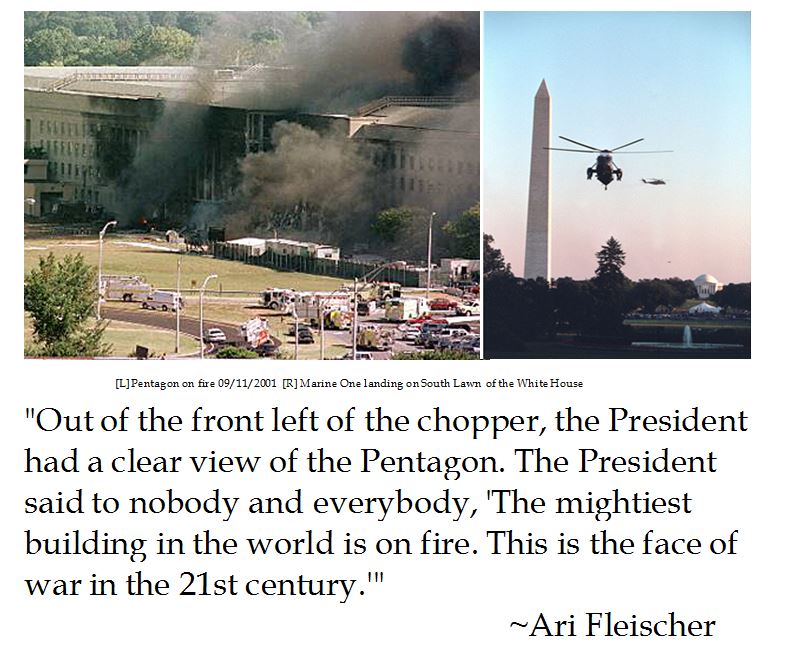
This is the Face of War in the 21st Century

Bush Press Secretary Ari Fleischer quotes the President on 21st Century warfare


H/T: Politico

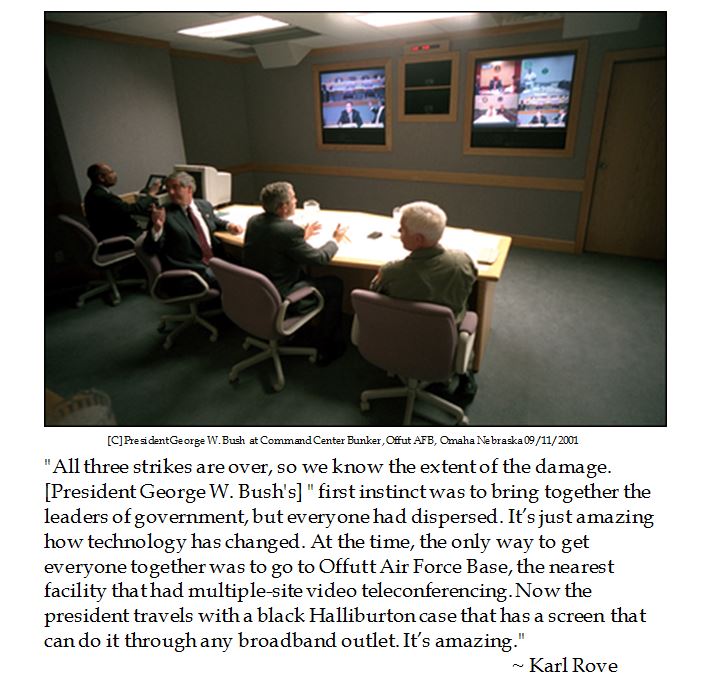
Karl Rove on the Fog of War after 9/11

Bush Special Advisor Karl Rove on 9/11


 H/T: Politico

On Going Down into the Bunker on 9/11

White House Stenographer Ellen Eckhert Recalls 9/11 at Offutt AFB bunker


H/T: Politico

Remembering 9/11 Victims


A dozen years ago, two planes were hijacked by jihadist terrorists under the direction of Osama bin Laden and they were deliberately flown into the Twin Towers of the World Trade Center in New York City.  Within two hours, both towers fell, killing 2,118 civilians in the building, 147 crew and passengers from American Airlines Flight 11 and United Airlines Flight 175 along with 11 hijackers.

Here is raw footage with raw sound from that chaotic day in lower Manhattan--


New York City chose to memorialize all of the innocent dead by creating a park with two waterfalls in the footprints of the Twin Towers, building a 1,176 foot high One World Trade Center (originally designated the Freedom Tower) and a$600 Million  museum to memorialize the horrific day.


There has been some controversy concerning the 9/11 memorials at Ground Zero in NYC.  It took over a decade to erect a new building which was meant to show American resolve.  The signature new World Trade Center building legally changed its name from the 102 story $3.1 Billion Freedom Tower to accommodate a 21 year lease with Vantone, a Chinese commercial realty company.  The 9/11 museum drew fire for featuring the jihadist hijackers "for the  historical narrative".  Some have complained that political correctness has gone made at Ground Zero erasing anything heroic, patriotic or influencing the narrative.  Atheists even tried to exclude a cross formed by two steel beams in the WTC collapse that gave many Ground Zero rescue workers solace, but fortunately courts denied this claim.


On September 11th 2001 at 9:37 a.m., American Airlines Flight 77 flew into a first floor western facing wall of the Pentagon.  The crash killing 125 people on the ground (including 55 civilians)   53 passengers, six crew and five jihadist hijackers

Defense Secretary Donald Rumsfeld (third from right) assists with the injured at the Pentagon 9/11/2001


.The 184 victims of the attack on the Pentagon were honored in an outdoor memorial on the southwest corner of the Pentagon which was designed by Julie Beckman and Steve Kaseman with 184 illuminated benches arranged by age and whether they were in the building or aboard the terrorist hijacked aircraft.


United Airlines Flight 93, the Newark to San Francisco scheduled flight with a crew of seven and 33 passengers was hijacked by four jihadist terrorists.


The passengers revolted against the hijackers after learning of the other hijackings. Flight 93 crashed in rural Somerset County, Pennsylvania.  It was  believed that had the jihadist hijackers prevailed, the plane was headed to crash into the US Capitol.  But in 2009 a high ranking al Qaeda detainee revealed that Flight 93's specific target was  White House. Whatever the case, these heroic passengers were first conscious US combatants in the War on Terrorism.


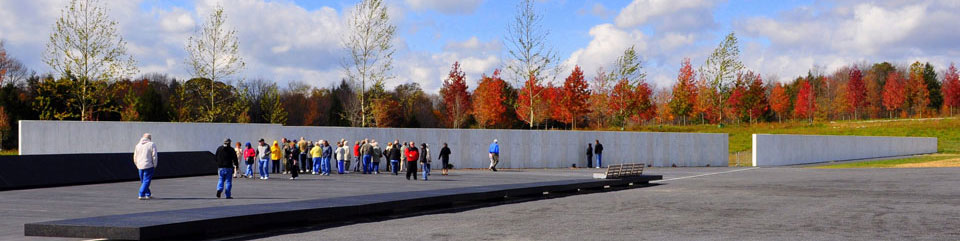
There was some controversy with the original design of the Flight 93 memorial in Shanksville, Pennsylvania. The memorial originally was supposed to include 40 groves of red maple trees shaped like a crescent.  To quiet the debate, the 93 foot Tower of Voices has 40 wind chimes and a grove of 40 red maple trees which circle the walkway, following the bowl shape of the former surface mine.


As time has passed, the September 11th 2001 attack could fall into the recesses of memory for many Americans directly untouched by the fanatical atrocity. May we always remember the 9/11 victims and never forget the American virtues which made US a target of those wishing to establish a world-wide Caliphate.