Showing posts with label George W. Bush. Show all posts

Thursday, December 17, 2020

On Entitlement and Narratives


Now that the mainstream media has moved on with the presumption that Joe Biden is the President-elect, the chatter is now about the trappings of his Administration.  As the public is growing accustomed to “the new normal”, there is a kerfluffel concerning honorifics attached to the First Lady, Jill Biden.  Staff surrounding the wife of the President-elect have made it clear that she be referred to as “Doctor” Jill Biden.  

Jill Biden earned her Bachelor of Arts from the University of Delaware in English in 1975.  Jill Biden earned a  Masters degree in education with a specialty of Reading from West Chester State College  in 1981 while working as a teacher.  In 1987, Jill got a Masters in English from Villanova University. Years later, she returned to school for her doctoral studies under her birth name Jill Jacobs. In January 2007, she was awarded a Doctor of Education (Ed.D) degree from the University of Delaware in “Educational Leadership”. She published  her dissertation: Student Retention at the Community College: Meeting Students’ Needs as Jill Jacobs-Biden.  The thrust of her thesis is that Delaware Technical and Community College (where she was an instructor) needed a Student Center. 

So Jill Jacobs-Biden earned a BA, a MA in Reading, a MA in English, and a Ed.D in Educational Leadership. That is a bit of sheepskin to hang on the walls. The specialty education in reading probably was quite instructive as Jill acted as a reading specialist.  Dr. Jill prowess as an Education Leader combined with her intimate connection to a 34 year senior Senator from Delaware likely scared up funding for the Community College’s student centers (as there are multiple campuses). 

That being said, it seems a bit presumptuous to demand that the public and the pliant press refer to her as Doctor Jill Biden.   Being a political junky, I’m reminded of when former Senator Barbara Boxer (D-CA) dressed down a polite General testifying on Capitol Hill for calling her “Ma’am”, as she had worked so hard to get that title of Senator.  Of course, who can forget Dr. Evil from Austin Powers demanding his honorific after six years in evil medical school.


Not all public figures choose to preen their pedigrees.  Even though Bill Cosby also earned a Doctor of Education degree, he did not insist on being addressed with the honorific “Doctor”.  Then there is Ben Carson, a world wide renowned brain surgeon who served as President Trump’s Secretary of Housing and Urban Development.  In his many media appearances, how often was he called Doctor (despite his medical degree) or did he insist on being addressed by that title? 

America’s incoming Gaffer in Chief Joe Biden once explained why his wife sought higher degrees: 

“She said, ‘I was so sick of the mail coming to Sen. and Mrs. Biden. I wanted to get mail addressed to Dr. and Sen. Biden.’ That’s the real reason she got her doctorate.” 


 It is unclear if Joe Biden followed that up with his patent “I’m not joking.”   In some senses, the quote  might have been intentional deprecation to charm a lunch bucket audience.  Still, Joe often says uncomfortable off scripted things which reveal truths so judge for yourself. But Joe does not seem impressed by the aura of Dr. Jill’s status.

When a Wall Street Journal opinion writer penned a piece mocking Jill’s people insisting that she be called Dr. Biden, it created some controversy. Those prone to support a nascent Biden Administration defended Doctor Jill, claiming that calling her anything less was misogynistic. 

Tucker Carlson bothered to read her thesis and found it riddled with typos, creative math and extremely awkward phrasing, which seems striking considering her Master’s in English.  


Some parts sound slapdash and poorly edited.  Still the University of Delaware awarded her a Ed.D. 

Tucker Carlson rejected inevitable claims of sexist and affirmatively asserted that Jill was much smarter than her husband Joe.  Carlson’s conclusion was that the controversy swirls around classism, that there are expectations of a certain sort of person that they have the right credentials, be they academic or accorded by a prestigious professional position, not to create but to lord over you.   They have the presumption that their titles and status gives them “gravitas”.

While I can appreciate Tucker Carlson’s populist points, I believe that is only part of the story.  Culture plays some part in the application of honorifics.  In Latin countries, there is the tendency to address someone with a degree as “doctor” to lend credence to their arguments.  In Poland, they are sticklers in demanding the use of honorifics for doctors, academicians and professors.  But America was founded in an egalitarian environment which eschewed peerages and fancy titles.  

Generally, in our culture we reserve the honorific Doctor to those with medical degrees. In academic circles, they may apply doctor to give their dissertations distinction.  For some clergy who have garnered advanced degrees, such as the Dr. Martin Luther King, we accord that honorific. If one sought to be accurate, lawyers who have earned a Juris Doctor would be lawyers, but calling them Doctor would seem pretentious (especially after receiving their bills).  Even attorneys would insist on signing with Esquire or JD are deemed kind of pretentious.

Following George Washington’s wishes, even the US Chief Executive is given a diminished honorific “Mr. President”, although we accord it much more prestige due to the power he (or she) wields.  


But the presidential honorific is tempered with the esteem of the occupant.  Many feel that President Trump did not receive “all due respect” from a contemptuous press.  And after the shenanigans of the electoral Compromise of 1877, many referred to President Rutherford B. Hayes as “His Frauduency”.  I fear that unless the questions about election irregularities are cleared up before Biden’s inauguration, that mocking title may make a revival.


Being a denizen of the District, it is easy to see most things through a political lens.  Thus I believe that narrative is another important element of entitlement.  More than just Tucker Carlson’s assertion that people of a certain class are expected to have certain trappings, political opinion makers can spin them to give additional gravitas to those with whom they give favor.  President Barack Obama was portrayed as being a Constitutional because he taught at The University of Chicago.  But if one digs deeper into that assertion, Obama was only an instructor and his curriculum was more about Saul Alinsky and being a community activist. 


Defying Biden’s bumbling reputation, Joe Biden is esteemed in academia.  Joe Biden has honorary degrees from the University of Scranton (1976), St Joseph’s University (LLM 1981), Wiedener University Law (2000), Emerson College (2003), Delaware State University (LLD 2004), Suffolk University Law (2005), Syracuse University (LLD 2009), Wake Forest Univeristy (LLD 2009), the University of Pennsylvania (LLD 2013), Miami Dade College (2014), University of South Carolina (DPA 2014), Trinity College, Dublin (LLD 2016), Colby College (2016), and Morgan State University (DPS 2017).  See how smart you can look giving commencement speeches.  


But Joe Biden’s academic prowess does not stop there.  For years, Joe Biden co-taught a political science course at Wiedener University on Saturdays.  Joe Biden raised enough money under his name for the University of Pennsylvania to create the The Penn Biden Center for Diplomacy and Global Engagement.  Joe also joined the University of Pennsylvania Annenburg School of Arts and Sciences as Ben Franklin Presidential Practice Professor, but it is unclear if he actually taught anything there or if he served in other ways. 


The University of Delaware named their School of Public Policy after him as he donated his nearly half century of papers to them.  Some scholars wanted access to Senate paperwork during the campaign but they were off limits.  Enquiring minds want to know why. 

 In the minds of opinion makers, one has respectability with lots of degrees or holding diplomas from prominent schools, which can elicit the cynical retort:  “Oh sure, but he went to Harvard”.  


However, such  respect is not accorded to those on their political naughty list. Consider President George W. Bush.  As a Republican, one is typically typecast as evil or stupid.  In the case of “W”, it was the latter.  Bush was painted as being stupid, despite being an alum of Yale and earning a Masters in Business Administration from Harvard.  He went to the “right” schools but Bush isn’t a Democrat so he was demeaned as a dummy.  In fact, while occupying the Oval Office, President Bush read a book a week.  But that did not go with the prevailing narrative.

Ronald Reagan did not have storied academic career, earning a BA from Eureka College.  Reagan was typecast in critical conventional wisdom as an amiable actor who knew how to read his script in “B” movies, the TV teleprompter and on the radio.  Yet after his death, it was discovered that his weekly scripts which delved deep into political conservatism was written by his own hand.  But that contradicted the narrative foisted upon the public by elitist opinion makers.

This shaping of narrative is not limited to intellectual perceptions. Opinion makers can shape public perceptions of First Ladies too.   When she was First Lady, Michelle Obama was a fashion plate, adorning the covers of numerous magazines which glowed about her stylings, despite having a more muscular figure.  Then there is Melania Trump, who truly was a fashion model prior to coming to the White House, yet she has not been in one fashion magazine photo shoot or cover.  Some critics have criticized how the Slovenian immigrant can’t speak English well.  Of course that naysayer omitted that she speaks five languages. But pushing the narrative is more important.

To be fair with First Ladies, this narrative is not just shaped by the press or conventional wisdom. Pat Nixon did not want to be in the spotlight and wanted to support her husband’s middle class public persona.  So as early as the Checkers speech of 1952, she was content to wear that cloth coat and steer clear from fashion coverage.   President George Herbert Walker Bush’s wife Barbara cultivated the nickname “The Silver Fox” because of her grandmotherly demeanor. “Bar” was happy to play up the perception that her wardrobe mainly consisted of clothes from the Sears catalog.  Those narrative nuggets demonstrate how some choose to deprecate themselves rather than emphasize entitlement. 

Normally, narrative is entitlement in action by opinion makers.  I suspect that Jill’s insistence at being called "Doctor Jill" may be more than just an ego message.  Considering her degree in Educational Leadership and her numerous side-by-side appearances with her husband at their sparing 2020 campaign appearances, the public may be being set up for a more active role in a presumptive Biden Administration.  Doctor Jill may seek to have a guiding hand publicly as well as privately, for educational policy. There has been Democrat talking points about making Community College free to students and the pandering promise to wipe out student debt.

To paraphrase Dr. King, I personally wish for a world in which people are judged by the content of their character rather than the title of their honorific. And what a wonderful world it would be.


Wednesday, November 4, 2020

If Election 2020 Political Football Goes Into Overtime


As a political junkie, I have jested with friends and family that Presidential Elections are kind of a Superbowl for me.  Usually, the sturm und drang of a political campaign ends on election day.  In rare occasions, not so much.  Election 2000 stretched out through Thanksgiving that year due to the Florida recount. 


So when my beloved asked me how long would it be until we know who will be President next year, she was shocked when I suggested that it might be until January 4th.  What a fitting way to close out the annus horribilis of 2020.  I think that the field has been prepped for overtime in Political Fantasy Football resulting in a contested election scenario.


Granted, information may change by the hour, but on the evening after Election Day, the Democrat candidate Joseph Robinette Biden is thought to have 264 Electoral College votes, and Nevada is poised to surrender its six Electoral College votes, giving him a squeaker of a victory in the only metric which constitutionally matters.  Incumbent President Donald Trump is disputing an early call of Arizona’s 11 Electoral College votes.  


If Trump carries North Carolina, Georgia, Pennsylvania (battleground states where he is leading) and Arizona then Trump would win 274 votes and be re-elected.  Notwithstanding an outright victory, the Trump campaign has vowed to litigate against many instances of alleged voting irregularities, canvassing violations and potential fraudulent ballots for unvetted late mail in votes. Trump’s legal team has vowed to fight these violations, possibly even petitioning the US Supreme Court. 


This has the potential to impact results in key battleground states like Michigan, Wisconsin, Pennsylvania and Arizona.   If there are substantial cases, this may take time to litigate, which may delay or sway the official reporting of results.   Regardless of judicial outcome, if these violations are compelling, they may sway the process.


To refresh our civics knowledge, we do NOT live in a democracy but a Republic.  So when one casts a vote on election day for President, you are actually not voting for a Presidential candidate per se, you are voting for a slate of electors who then votes for the winning candidate in each state in the Electoral College, the ultimate party school. That’s how it normally works.  But technically, according to Article II Section 1 Clause 2 of the US Constitution, the power to name electors lies with state legislatures.  


Note well, this is a state legislature’s responsibility under federalism, which does not include input from a state Governor.  It is important to note that several battleground states with alleged voting irregularities, like Michigan, Wisconsin and Pennsylvania, have Republican majorities in their legislatures, despite having liberal Democrat Governors.   


It would be extraordinary, but not inconceivable, that Republican Legislatures may be convicted that voting irregularities which do not follow their legislation and would have be addressed when naming Electors for the Electoral College.  Obviously, Democrats would object to having their win overturned, so more than likely an alternative slate of Electors would attempt to be presented to the Electoral College.  And political mayhem ensues.


Presuming that the Constitution is followed, the legislature endorsed delegates would participate in the Electoral College vote on December 14th and that result would be sent to the US Senate. 


On January 3rd, the second duty of the Senate in the 117th Congress after their swearing in would be to ratify the Electoral College vote.  First vote decides the Vice President among the top two vote getters. Then the EC vote for President among the top three candidates. 


Normally, this is a pro forma vote and there is polite applause for whoever won the Election.  But in this scenario, Senators would challenge state slates of Electors.  This should be determined by a majority vote, with a tie being decided by the sitting Vice President (who is in office until January 20th).  If slates are thrown out and neither candidate gets a majority of Electors, then the contested election moves to the House of Representatives.


Even though Democrats have maintained their majority in the House, voting in a contested election is done by Representatives en banc via state.  Republicans have a 26 to 24 state majority in Congress, thus it would point to re-election of President Trump.  If there is not a majority of state delegations electing a President or Vice President by January 20th, then the Rep. Nancy Pelosi (D-CA 11th) or whoever is Speaker of the House at that time,  Acting President until the succession is determined. 


 Historically, there have been a few contested elections. In 2000, the Florida recount was settled by a Supreme Court decision in favor of George W. Bush.


 While the 1960 Presidential election was not formally disputed, the popular vote was only decided by 0.14% in favor of John Kennedy.  It is said that if 10,000 votes switched in four states, Richard Nixon would have become President in 1961. There were allegations of shenanigans in Texas and Illinois.  Moreover, there were 14 unpledged delegates in Mississippi and Alabama cast for Harry F. Byrd.  But Nixon did not want to divide the country so he did not fight. 


The 1876 Presidential Election was a quintessential case of a contested election.  Democrat Samuel Tilden won the Popular Vote but there were difficulties in the  Electoral College.  One of Oregon’s Electors was deemed ineligible as he was an elected official.  But Florida, South Carolina and Louisiana had competing Electors as each party sent slates, amounting to 19 more unresolved Electors.   To resolve this matter, Congress adopted an informal agreement known as the Compromise of 1877 which gave all 20 unresolved electoral votes to Republican Rutherford B. Hayes, thereby making him President.  In exchange, the federal government under Hayes withdrew Reconstruction troops that had been propping up carpet bagging state governments in Florida, South Carolina and Louisiana.  


Prior to the 2020 Elections, Democrats ran an election war game of a close election.  In this simulation Democrat activist John Podesta refused to concede and extracted political promises by threatening that West Coast states, such as California, Oregon and Washington would leave the Union unless they got their way.   This obstinate political modus operandi seems to echo the extracted promises from the Compromise of 1877. 


A hypothetical overtime in political football seems pretty theoretical but strange things have happened in 2020. We may be suffering from the Chinese curse of “May you live in interesting times”, even without  Joe Biden assuming the Oval Office.

Friday, September 11, 2020

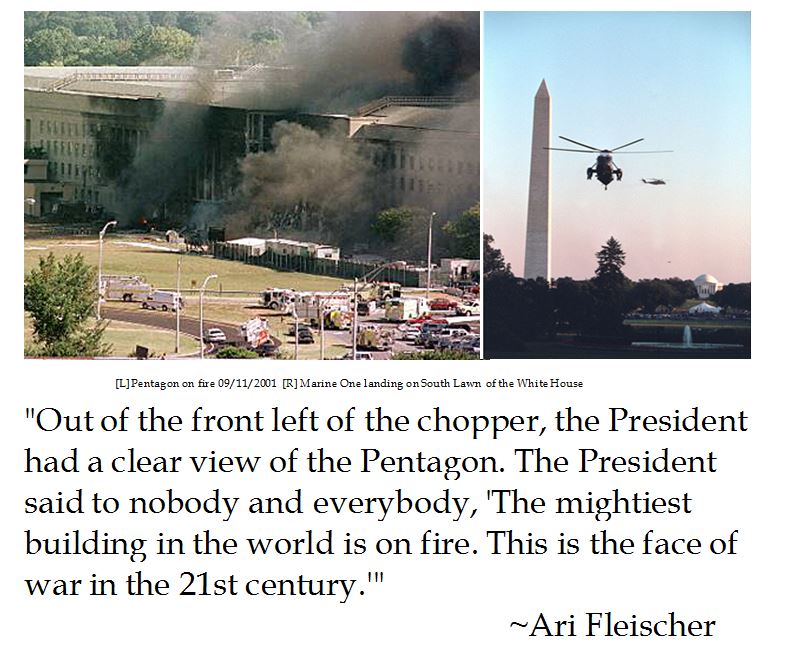
This is the Face of War in the 21st Century

Bush Press Secretary Ari Fleischer quotes the President on 21st Century warfare


H/T: Politico

On Going Down into the Bunker on 9/11

White House Stenographer Ellen Eckhert Recalls 9/11 at Offutt AFB bunker


H/T: Politico

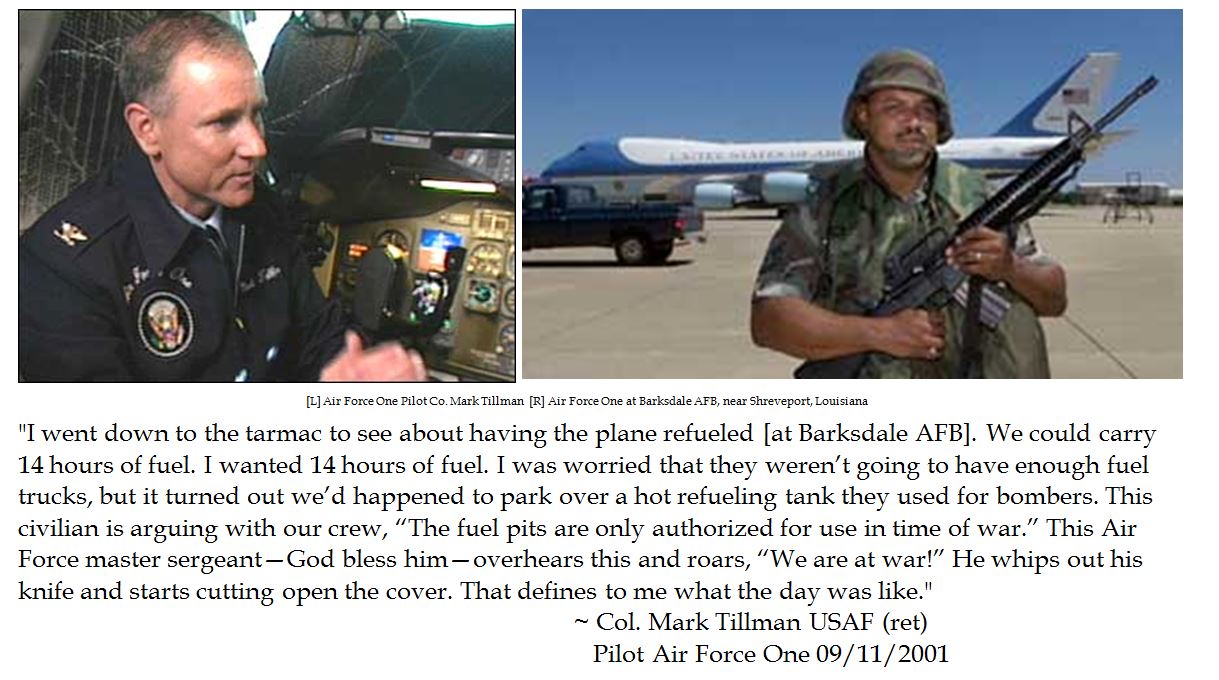
Air Force One Pilot Remembers 9/11

Air Force One pilot Col. Mark Tillman's recollection of 9/11

Despite President George W. Bush's persistent entreaties to return to the White House on the morning of September 11th 2001, the Secret Service would not permit the Commander in Chief to return to Washington for fear that he might be a target. There was chatter about "Angel" (which is the code word for the Air Force One) being next. 

So after departing Sarasota, Air Force One flew to Barksdale Air Force Base, in Shreveport, Louisiana. 


Air Force One's pilot Col Mark Tillman, wanted to make sure that the aircraft had a full tank of fuel as it was unsure where the President would go next.  A civilian argued that 14 hours of fuel was only for a time a war, but a Air Force Master Sergeant, impressed upon the crew that we are in a time of war.

H/T: Politico

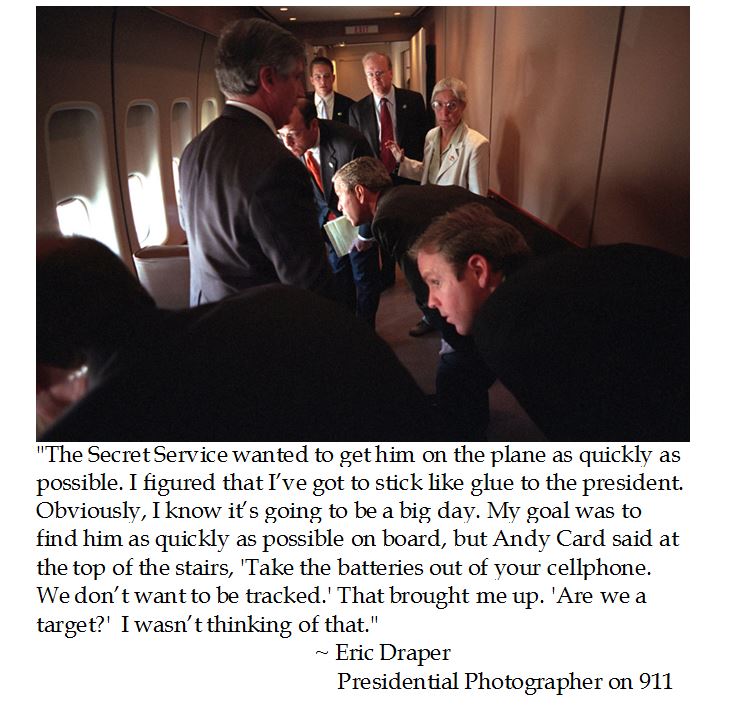
Presidential Photographer on 9/11

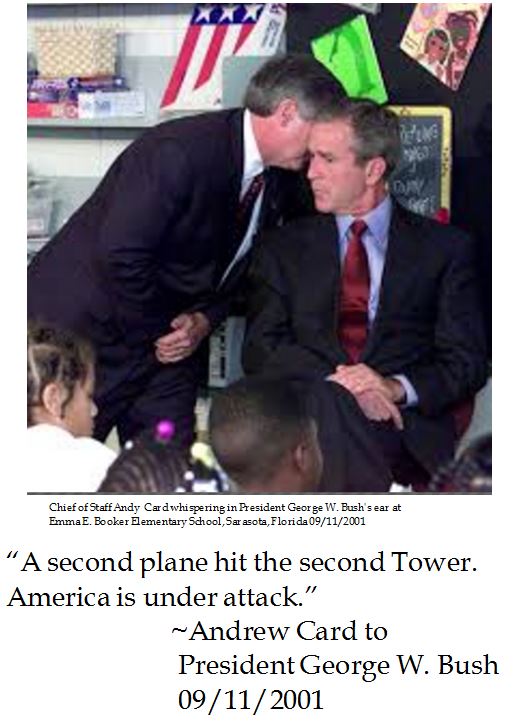
America is Under Attack on 9/11

George W. Bush Chief of Staff Andy Card on 9/11

As the world looks back on the atrocities of September 11th 2001, we forget that it was a different world. In Farenheit 911 (2004), Michael Moore mocked how President George W. Bush continued to read "My Pet Goat" to a group of schoolchildren in Sarasota, Florida as the Twin Towers burned.  But a Politico magazine article of oral histories of 9/11 points out how scant communications were that day.  Cellular technology was not as prevalent and it was challenging to get media while out of pocket.


President Bush went about the pre-planned No Child Left Behind event when his Chief of Staff Andy Card whispered in his ear about the second plane crashing.  President Bush remained calm and continued reading, knowing that he could do nothing immediately with imperfect information.

Tuesday, September 11, 2018

Remembering 9/11 Victims


Seventeen years ago, two planes were hijacked by jihadist terrorists under the direction of Osama bin Laden and they were deliberately flown into the Twin Towers of the World Trade Center in New York City.  Within two hours, both towers fell, killing 2,118 civilians in the building, 147 crew and passengers from American Airlines Flight 11 and United Airlines Flight 175 along with 11 hijackers.

Here is raw footage with raw sound from that chaotic day in lower Manhattan--


New York City chose to memorialize all of the innocent dead by creating a park with two waterfalls in the footprints of the Twin Towers, building a 1,176 foot high One World Trade Center (originally designated the Freedom Tower) and a $600 Million  museum to memorialize the horrific day.


Ground Zero Memorial, New York City

There has been some controversy concerning the 9/11 memorials at Ground Zero in NYC.  It took over a decade to erect a new building which was meant to show American resolve.  The signature new World Trade Center building legally changed its name from the 102 story $3.1 Billion Freedom Tower to accommodate a 21 year lease with Vantone, a Chinese commercial realty company.  The 9/11 museum drew fire for featuring the jihadist hijackers "for the  historical narrative".  Some have complained that political correctness has gone made at Ground Zero erasing anything heroic, patriotic or influencing the narrative.  Atheists even tried to exclude a cross formed by two steel beams in the WTC collapse that gave many Ground Zero rescue workers solace, but fortunately courts denied this claim.

On September 11th 2001 at 9:37 a.m., American Airlines Flight 77 flew into a first floor western facing wall of the Pentagon.  The crash killing 125 people on the ground (including 55 civilians)   53 passengers, six crew and five jihadist hijackers


Defense Secretary Donald Rumsfeld (third from right) assists with the injured at the Pentagon 9/11/2001

The 184 victims of the attack on the Pentagon were honored in an outdoor memorial on the southwest corner of the Pentagon which was designed by Julie Beckman and Steve Kaseman with 184 illuminated benches arranged by age and whether they were in the building or aboard the terrorist hijacked aircraft.


United Airlines Flight 93, the Newark to San Francisco scheduled flight with a crew of seven and 33 passengers was hijacked by four jihadist terrorists.


The passengers revolted against the hijackers after learning of the other hijackings. Flight 93 crashed in rural Somerset County, Pennsylvania.  It was  believed that had the jihadist hijackers prevailed, the plane was headed to crash into the US Capitol.  But in 2009 a high ranking al Qaeda detainee revealed that Flight 93's specific target was  White House. Whatever the case, these heroic passengers were first conscious US combatants in the War on Terrorism.


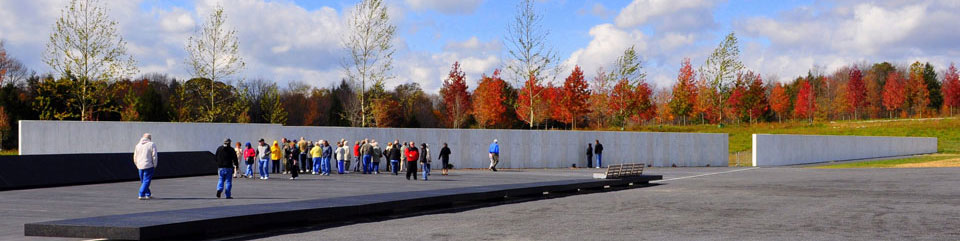
There was some controversy with the original design of the Flight 93 memorial in Shanksville, Pennsylvania. The memorial originally was supposed to include 40 groves of red maple trees shaped like a crescent.  To quiet the debate, the 93 foot Tower of Voices has 40 wind chimes and a grove of 40 red maple trees which circle the walkway, following the bowl shape of the former surface mine.


As time has passed, the September 11th 2001 attack could fall into the recesses of memory for many Americans directly untouched by the fanatical atrocity. May we always remember the 9/11 victims and never forget the American virtues which made US a target of those wishing to establish a world-wide Caliphate.

[This piece previously was published on District of Calamity]

Monday, September 11, 2017

9/11 and Global Guardian


As America commemorates the  anniversary of the September 11th 2001 attacks by Islamic terrorists, the sting of the memory may have grown faint in some circles. Whether it is due to the passage of time or the widespread reluctance to show the terrible videos about planes hitting the Twin Towers of the World Trade Center, the Pentagon and Shanksville PA, killing nearly 3,000 souls that day. So the producers of a commercial showing the collapse of twin towers of mattresses might not have struck them as being offensive humor.

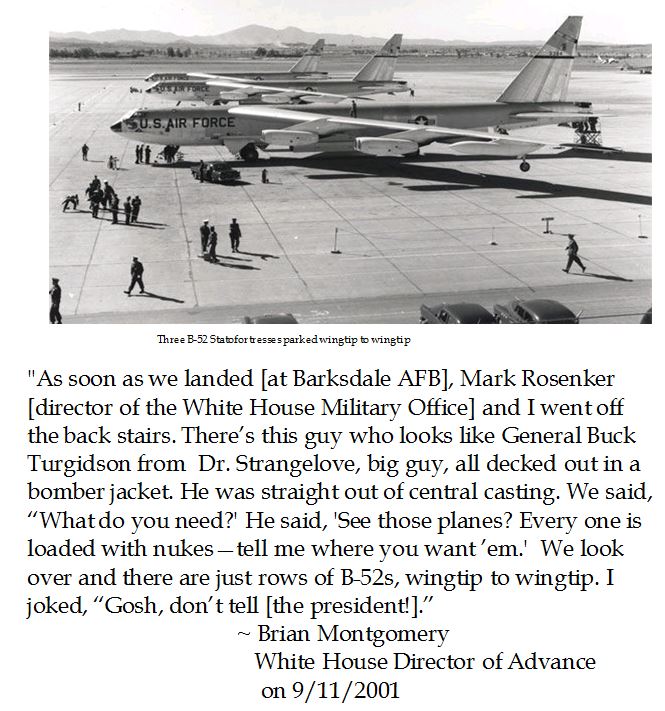
However, Bush White House Director of Advance Brian Montgomery had a slightly sardonic memory of that dark day preparing for an impromptu stop at Barksdale AFB on September 11, 2001, as it seemed like Dr. Strangelove surrealism. 


The Secret Service was very protective of the President and were chary about returning to the White House to avoid the possibility of a decapitation strike. This sensibility was reinforced especially after hearing chatter that "Angel" (code name for Air Force One) was "next".  So the Presidential entourage was diverted to Barksdale AFB in Shreveport, Louisiana.

It so happened that on that very day, the 8th Air Force based at Barksdale AFB was in the midst of their annual big exercise Global Guardian, including having loaded bombers at the ready.   So Barksdale AFB was already proceeding in a THREATCON Delta mode.  So when Advance Director Montgomery disembarked from Air Force One, he could see the B-52 Stratsfortress bombers lined up wing-to-wing it seemed surreal.

Bush White House Advance Director Brian Montgomery Recalls 9/11 at Barksdale AFB

Adding to the surreal scene was being met by a military man who looked like ready to roll General Buck Turgidson telling him that the squadron of B-52s were loaded with nukes, no wonder Montgomery thought of Dr. Strangelove.

Better to work with a guy looking like General Buck Turgidson than guy acting like General Ripper. However, to all reports, once the second plane hit the World Trade Center everyone in the military was on war footing.  

And despite less than ideal communications on Air Force One, President George W. Bush was able to reach out to Russian Federation President Vladimir Putin. Bush White House Press Secretary Ari Fletcher recalled: "Putin was fantastic that day.  He was a very different Vladimir Putin in 2001. America could have had no better ally on September 11th than Russia and Putin. Putin  accepted the President Bush's reassurances that America was under attack and hostilities were not directed towards Russia. 

President Bush exiting Air Force One on September 11,2001 with "Doomsday Plane" in the background

So despite "Angel" landing next to a fully loaded nuclear squadron of B-52's and being met on the tarmac by a guy who was a doppelganger for General Buck Turgidson, there was little chance on 9/11 that life would imitate art in Dr. Strangelove's (1964) climactic ending.


H/T Politico

President George W. Bush on 9/11

President George W. Bush on 9/11


Wednesday, October 5, 2016

Vetting the Vice Presidential Debate


Democrat Vice Presidential nominee Senator Tim Kaine (D-VA) and Republican Vice Presidential nominee Governor Mike Pence (R-IN) squared off in their only 2016 Election Vice Presidential Debate in Farmville, Virginia.  

Much of the District of Calamity’s punditocracy  expected the VP Debate to be a snoozer.  After all, in prior VP Debates there were few memorable moments, aside from the 1988 Senator Lloyd Bentsen (D-TX) putdown of then Senator Dan Quayle (D-IN) “You’re no Jack Kennedy” and Admiral James Stockdale’s (Reform- CO) 1992 awkward self introduction: “Who am I and why am I here.”

A Washington Post Pregame panel postulated that there was even a chance that Kaine and Pence might civilly engage in some substance.  


Boy, were we wrong. While the VP Debate lacked the memorable insults from the First Presidential Debate between Donald Trump (R-NY) and Hillary Clinton (D-NY), sparks certainly flew.


Almost from the opening salvos, Kaine employed a strategy of interrupting his opponent and being persistently provocative.  This seemed so unexpected, considering Kaine's boring reputation. During the 90 minute debate, Kaine interrupted Pence 70 times, whereas Pence reciprocated only 39 times. But Kaine’s high energy approach and often employed canned ham made his interruptions seem much more obnoxious and irritating. 

The only thing that seemed to shut Kaine up was when Pence contrasted his accomplishments as Governor of Indiana with then Governor Kaine's record in the Commonwealth of Virginia.  As a loyal soldier, Kaine apparently took the verbal spearing for raising taxes and increasing the deficit rather than take attention away from his running mate.

Senator Kaine’s rapid fire insults certainly sought to empty the verbal armory on Trump/Pence. But by badgering and using a fast talking facade, Kaine did not allow many of his attacks to gain resonance. Pence exuded the guise of being a mild-mannered Midwesterner, speaking in a less caffeinated cadence and seeming courtly. In addition, Pence masterfully credited Obama/Hillary and Kaine by recognizing their positives before tearing them down.  But these civil strategies certainly does not to suggest that Pence did not try to rhetorically draw blood from his opponent.

It seems that Kaine embraced his role of being Hillary’s attack dog and had prepared for the VP debate by memorizing myriad Trump attacks. Rather than being lured down the rabbit hole to defend each of these charges, Pence let his experience as a talk show host guide him to selectively respond.  After the stage lights dimmed, Pence's selective deflections of alleged Trump outrageous statements might be criticized as being insufficiently supporting his running mate or as opposition sound byte fodder.  But Trump revels in making big bold statements which he later modifies, so it can be exhausting to defend the indefensible. 

Senator Kaine kept bringing up the Trump tax returns.  This class warfare cudgel was wise wedge politics, it emphasized an arguable Trump flip-flop  and was certainly au currant with the illicit New York Times tax forms leak.  But repeatedly going to that well diminished its impact and then made it too obvious that it was pre-planned talking points. This was especially evident when Kaine renewed the Trump tax attack when the topic was supposed to be about North Korea nuclear weaponization.

After Kaine returned to the Trump tax routine for the sixth time,  Pence parlayed the point into some political jujitsu.  Pence countered by explaining the appearance of influence peddling which the Clinton Foundation has while Ms. Clinton was Obama's Secretary of State.  At that point, CBS moderator  Elaine Quijano cut Pence off.

While Pence comparatively spoke slowly during the debate, he allowed his analogies and attacks sink in.  Pence twice used geographical metaphors to counter Kaine's contentions.  To criticize Hillary Clinton's economic intentions, Pence referred to a mountain range of debt. Later, Pence poo-pooed Hillary's attack dog sneering an "avalanche of insults".  In our hyper-kinetic, post literate culture, being able to evoke mental pictures through words can really make an impact.  Again, this may be due to Pence's prior career on radio.

When candidates command a national audience at a debate, it is prudent to make appeals to certain voting groups.  Kaine clearly went after the womens' vote with the "Why don't you trust women to decide" on late term abortions, while shredding his faithful credentials among practical Catholics. But what was a mystery was how ineffective Kaine was in exploiting immigration.  Even though Pence chided Kaine for keep going back to "that Mexican thing", he did not make strong positive appeals to Hispanic voters.  Kaine has the background of being an Ignatian volunteer (he was never a Jesuit) in Central America and is proficient in Spanish.  In fact, he pandered en la lengua during the Philadelphia convention. Instead, it seemed that he wanted to paint Trump/Pence as "racists" for wanting to slow immigration without thorough vetting of Syrian refugees.  If Kaine's goal was to bolster the base and get out the vote, his VP Debate strategy was flawed.

Democrats are reliant of winning the black vote.  In this cycle, polling indicates that Democrats have a near lock on that segment of the voting public, but the question is whether African American voters will come out in droves to the polling place when Barack Obama is not on the ticket.  Kaine's appeal to Black voters seemed to turn on exploiting a yet  unadjudicated controversial police shooting of Philandro Castile. 

Kaine probably cited this Minnesota shooting as a way to pander to the Black Lives Matter crowd without uttering their name. But by the same token, it looks obvious that it is exploiting a tragedy and not respecting law enforcement officers presumption of innocence or right to a fair trial. If one dug into details, it was weird that the victim's girlfriend live streamed the shooting on Facebook  and ignores the guy's numerous prior encounters.  But it allowed Kaine's opponent to pitch Trump's Law and Order, mantra, as well as a Support the Police message while expressing agreement on Community Policing. 

In purely tactical terms,  Minnesota is not a battleground state and Philandro Castile is not a household name for the Black Voters as Trayvon Martin was in 2012. So Kaine's police violence forays did not win new support nor generally bolstered battleground states.  It might have been more strategic  for Kaine to point to the shooting in Charlotte, North Carolina.  But in doing so, it would not exploit the racial wedge subtext.

Pence seemed more tactical in giving his shout outs.  When touting the efficacy of stop and frisk, Pence highlighted how such a policy policy increases safety for good citizens in the inner cities, thus continuing the Trump appeal to African Americans,  In pointing out how economic recovery has not reached many Americans, Pence specifically cited Scranton (PA) and Fort Wayne as working class places which have not seen the sunny side of employment numbers.  This gave a shout out to key voters in a battleground state (ironically current Vice President "Lunch Bucket" Joe Biden's hometown). This was skillful and sounded natural.

What was remarkable for a Republican was to make an explicit appeal for pro-life voters.  The final formal question was to elucidate how each candidate was challenged in being faithful to his convictions as he acted as a public official.  

Mike Pence directed his answer to the sanctity of life and how he worked to make Indiana the most pro-adoptive state in America.  But Pence continued by questioning the conundrum of how his opponent can claim to be pro-life but politically countenance partial-term abortion.  

Kaine countered by claiming that Trump/Pence wants to punish women who make "reproductive choices". And then to slam Trump's waffling, Kaine quoted the gospel of Matthew: "From fullness, the heart speaks".   Kaine was so busy attacking on abortion that he failed to hit Pence on RFRA, which came to a flash point in the Hoosier State and could sway Same-Sex marriage supporters.

Pence rejoined by echoing St. Mother Teresa and noting  that a society can be judged by how it deals with the most vulnerable.  By emphasizing partial birth abortion, Pence made a pro-life appeal with which  90% of Americans agree and may bolster support from conservatives skeptical about supporting Trump.

Aside from being the designated attack dog, a Vice Presidential nominee on the hustings is often employed to counter deficiencies on the top of the ticket. For instance, in the 2000 Election then Governor George W. Bush (R-TX) was perceived as an inexperienced Washington outsider, so he chose consummate Between the Beltways insider ex Rep. Dick Cheney (R-WY) to give him "gravitas" in a running mate.

In this cycle, Governor Mike Pence may well have been picked as an outreach to conservatives with solid Washington and outsider experience by a novice nationalist populist politician like Donald Trump.  But Pence also offers a contrast in temperament.  Trump is known for his flamboyant, outrageous and unpredictable style, whereas Pence proved in the VP Debate that he was cool, civil and steady.  

On the other end of the political pendulum this year, a self-professed progressive Hillary Clinton chose left-leaning Tim Kaine, seemingly to win to Virginia and bank on his identity politics of being a Catholic with outreach to Hispanics.  As experienced of an insider as Mrs. Clinton is, she is not a natural politician and does not exude an inviting public personality that is believable.  A feasible mission for Kaine during the VP Debate should have been to make his running mate seem warm and fuzzy.  Instead, most people will remember the Democrat VP as acting like an obnoxious, argumentative jerk who kept interrupting.  This did nothing to mollify Hillary's warmness gap and it made many Democrats agitated at Kaine's discourtesy. 

It is dubious if a Vice Presidential debate matters much in the scheme of a Presidential election.  We could read the transcript to digest the alluvia of assertions and insults, but it did not seem that there were any measurable moments which encapsulate the event.  But I am reminded of what Maya Angelou's pearl of wisdom that: "People may forget what you've said, people will forget what you did but they will never forget how you made them feel."   Considering that both major party candidates would be septagenarian Commanders-in-Chief, and one has many prospective health challenges, voters need to seriously consider that the VP might actually occupy the Oval Office.  This debate made Mike Pence look statesman-like, steady and civil, which helps Trump out as well as himself. Unfortunately, Kaine seemed like a smarmy, supercilious candidate who does not play well with others. That might stick in the minds of some voters who will remember that a vote for Hillary is a vote for Kaine.


Democrat Vice Presidential nominee Senator Tim Kaine (D-VA) and Republican Vice Presidential nominee Governor Mike Pence (R-IN) squared off in their only 2016 Election Vice Presidential Debate in Farmville, Virginia.  

Much of the District of Calamity’s punditocracy  expected the VP Debate to be a snoozer.  After all, in prior VP Debates there were few memorable moments, aside from the 1988 Senator Lloyd Bentsen (D-TX) putdown of then Senator Dan Quayle (D-IN) “You’re no Jack Kennedy” and Admiral James Stockdale’s (Reform- CO) 1992 awkward self introduction: “Who am I and why am I here.”

A Washington Post Pregame panel postulated that there was even a chance that Kaine and Pence might civilly engage in some substance.  


Boy, were we wrong. While the VP Debate lacked the memorable insults from the First Presidential Debate between Donald Trump (R-NY) and Hillary Clinton (D-NY), sparks certainly flew.


Almost from the opening salvos, Kaine employed a strategy of interrupting his opponent and being persistently provocative.  This seemed so unexpected, considering Kaine's boring reputation. During the 90 minute debate, Kaine interrupted Pence 70 times, whereas Pence reciprocated only 39 times. But Kaine’s high energy approach and often employed canned ham made his interruptions seem much more obnoxious and irritating. 

The only thing that seemed to shut Kaine up was when Pence contrasted his accomplishments as Governor of Indiana with then Governor Kaine's record in the Commonwealth of Virginia.  As a loyal soldier, Kaine apparently took the verbal spearing for raising taxes and increasing the deficit rather than take attention away from his running mate.

Senator Kaine’s rapid fire insults certainly sought to empty the verbal armory on Trump/Pence. But by badgering and using a fast talking facade, Kaine did not allow many of his attacks to gain resonance. Pence exuded the guise of being a mild-mannered Midwesterner, speaking in a less caffeinated cadence and seeming courtly. In addition, Pence masterfully credited Obama/Hillary and Kaine by recognizing their positives before tearing them down.  But these civil strategies certainly does not to suggest that Pence did not try to rhetorically draw blood from his opponent.

It seems that Kaine embraced his role of being Hillary’s attack dog and had prepared for the VP debate by memorizing myriad Trump attacks. Rather than being lured down the rabbit hole to defend each of these charges, Pence let his experience as a talk show host guide him to selectively respond.  After the stage lights dimmed, Pence's selective deflections of alleged Trump outrageous statements might be criticized as being insufficiently supporting his running mate or as opposition sound byte fodder.  But Trump revels in making big bold statements which he later modifies, so it can be exhausting to defend the indefensible. 

Senator Kaine kept bringing up the Trump tax returns.  This class warfare cudgel was wise wedge politics, it emphasized an arguable Trump flip-flop  and was certainly au currant with the illicit New York Times tax forms leak.  But repeatedly going to that well diminished its impact and then made it too obvious that it was pre-planned talking points. This was especially evident when Kaine renewed the Trump tax attack when the topic was supposed to be about North Korea nuclear weaponization.

After Kaine returned to the Trump tax routine for the sixth time,  Pence parlayed the point into some political jujitsu.  Pence countered by explaining the appearance of influence peddling which the Clinton Foundation has while Ms. Clinton was Obama's Secretary of State.  At that point, CBS moderator  Elaine Quijano cut Pence off.

While Pence comparatively spoke slowly during the debate, he allowed his analogies and attacks sink in.  Pence twice used geographical metaphors to counter Kaine's contentions.  To criticize Hillary Clinton's economic intentions, Pence referred to a mountain range of debt. Later, Pence poo-pooed Hillary's attack dog sneering an "avalanche of insults".  In our hyper-kinetic, post literate culture, being able to evoke mental pictures through words can really make an impact.  Again, this may be due to Pence's prior career on radio.

When candidates command a national audience at a debate, it is prudent to make appeals to certain voting groups.  Kaine clearly went after the womens' vote with the "Why don't you trust women to decide" on late term abortions, while shredding his faithful credentials among practical Catholics. But what was a mystery was how ineffective Kaine was in exploiting immigration.  Even though Pence chided Kaine for keep going back to "that Mexican thing", he did not make strong positive appeals to Hispanic voters.  Kaine has the background of being an Ignatian volunteer (he was never a Jesuit) in Central America and is proficient in Spanish.  In fact, he pandered en la lengua during the Philadelphia convention. Instead, it seemed that he wanted to paint Trump/Pence as "racists" for wanting to slow immigration without thorough vetting of Syrian refugees.  If Kaine's goal was to bolster the base and get out the vote, his VP Debate strategy was flawed.

Democrats are reliant of winning the black vote.  In this cycle, polling indicates that Democrats have a near lock on that segment of the voting public, but the question is whether African American voters will come out in droves to the polling place when Barack Obama is not on the ticket.  Kaine's appeal to Black voters seemed to turn on exploiting a yet  unadjudicated controversial police shooting of Philandro Castile. 

Kaine probably cited this Minnesota shooting as a way to pander to the Black Lives Matter crowd without uttering their name. But by the same token, it looks obvious that it is exploiting a tragedy and not respecting law enforcement officers presumption of innocence or right to a fair trial. If one dug into details, it was weird that the victim's girlfriend live streamed the shooting on Facebook  and ignores the guy's numerous prior encounters.  But it allowed Kaine's opponent to pitch Trump's Law and Order, mantra, as well as a Support the Police message while expressing agreement on Community Policing. 

In purely tactical terms,  Minnesota is not a battleground state and Philandro Castile is not a household name for the Black Voters as Trayvon Martin was in 2012. So Kaine's police violence forays did not win new support nor generally bolstered battleground states.  It might have been more strategic  for Kaine to point to the shooting in Charlotte, North Carolina.  But in doing so, it would not exploit the racial wedge subtext.

Pence seemed more tactical in giving his shout outs.  When touting the efficacy of stop and frisk, Pence highlighted how such a policy policy increases safety for good citizens in the inner cities, thus continuing the Trump appeal to African Americans,  In pointing out how economic recovery has not reached many Americans, Pence specifically cited Scranton (PA) and Fort Wayne as working class places which have not seen the sunny side of employment numbers.  This gave a shout out to key voters in a battleground state (ironically current Vice President "Lunch Bucket" Joe Biden's hometown). This was skillful and sounded natural.

What was remarkable for a Republican was to make an explicit appeal for pro-life voters.  The final formal question was to elucidate how each candidate was challenged in being faithful to his convictions as he acted as a public official.  

Mike Pence directed his answer to the sanctity of life and how he worked to make Indiana the most pro-adoptive state in America.  But Pence continued by questioning the conundrum of how his opponent can claim to be pro-life but politically countenance partial-term abortion.  

Kaine countered by claiming that Trump/Pence wants to punish women who make "reproductive choices". And then to slam Trump's waffling, Kaine quoted the gospel of Matthew: "From fullness, the heart speaks".   Kaine was so busy attacking on abortion that he failed to hit Pence on RFRA, which came to a flash point in the Hoosier State and could sway Same-Sex marriage supporters.

Pence rejoined by echoing St. Mother Teresa and noting  that a society can be judged by how it deals with the most vulnerable.  By emphasizing partial birth abortion, Pence made a pro-life appeal with which  90% of Americans agree and may bolster support from conservatives skeptical about supporting Trump.

Aside from being the designated attack dog, a Vice Presidential nominee on the hustings is often employed to counter deficiencies on the top of the ticket. For instance, in the 2000 Election then Governor George W. Bush (R-TX) was perceived as an inexperienced Washington outsider, so he chose consummate Between the Beltways insider ex Rep. Dick Cheney (R-WY) to give him "gravitas" in a running mate.

In this cycle, Governor Mike Pence may well have been picked as an outreach to conservatives with solid Washington and outsider experience by a novice nationalist populist politician like Donald Trump.  But Pence also offers a contrast in temperament.  Trump is known for his flamboyant, outrageous and unpredictable style, whereas Pence proved in the VP Debate that he was cool, civil and steady.  

On the other end of the political pendulum this year, a self-professed progressive Hillary Clinton chose left-leaning Tim Kaine, seemingly to win to Virginia and bank on his identity politics of being a Catholic with outreach to Hispanics.  As experienced of an insider as Mrs. Clinton is, she is not a natural politician and does not exude an inviting public personality that is believable.  A feasible mission for Kaine during the VP Debate should have been to make his running mate seem warm and fuzzy.  Instead, most people will remember the Democrat VP as acting like an obnoxious, argumentative jerk who kept interrupting.  This did nothing to mollify Hillary's warmness gap and it made many Democrats agitated at Kaine's discourtesy. 

It is dubious if a Vice Presidential debate matters much in the scheme of a Presidential election.  We could read the transcript to digest the alluvia of assertions and insults, but it did not seem that there were any measurable moments which encapsulate the event.  But I am reminded of what Maya Angelou's pearl of wisdom that: "People may forget what you've said, people will forget what you did but they will never forget how you made them feel."   Considering that both major party candidates would be septagenarian Commanders-in-Chief, and one has many prospective health challenges, voters need to seriously consider that the VP might actually occupy the Oval Office.  This debate made Mike Pence look statesman-like, steady and civil, which helps Trump out as well as himself. Unfortunately, Kaine seemed like a smarmy, supercilious candidate who does not play well with others. That might stick in the minds of some voters who will remember that a vote for Hillary is a vote for Kaine.