Showing posts with label Mitch McConnell. Show all posts

Thursday, January 14, 2021

Considering the Consequence of the Snap Second Trump Impeachment


On January 13th, 2021, the US House of Representatives voted to impeach President Donald J. Trump for a second time in a mostly party line vote 232 to 197 (with ten Republican voting aye).  This second Snap Impeachment in H. Res. 24 (117th Congress)  was on a single charge of “Incitement of Insurrection”, predicated on remarks made at a political rally at the Ellipse on January 6th, 2021 as Congress was set to certify the Electoral College results for the Presidential Election.   

After certification of the November 3rd election results, President Trump’s term ends on January 20th, meaning that the snap Impeachment, which only acts as a judicial equivalent of an indictment, was in the last seven days of President Trump’s term of office.  The Senate was not scheduled be in session until January 19th and current Senate Majority Leader Mitch McConnell (R-KY) was unwilling to convene in emergency session, so the earliest that the Senate could take up an Article of Impeachment (presuming that House Speaker Nancy Pelosi promptly send it over this time) is 1 p.m. on January 20th, one hour after newly inaugurated President Joe Biden takes his oath of office. 

Any astute political observers understand that this Second Impeachment was not meant to evict Mr. Trump out of the Oval Office but to besmirch his place in history and seek him from exercising any political power after January 20th.  Unfortunately, this political stunt has some serious repercussions for the polity, the rule of law and even the Constitution.

Firstly, there was a rush to remove President Trump.  When the Capitol Siege occurred on January 6th, Trump was only going to be in office for less than two weeks.  When the Snap Impeachment was passed, the 45th President would leave office in seven days. But that perspective only looks towards part of the consequences and not the cause.  Facts about the violence on Capitol Hill have been fluid.  Vital questions such as who were the instigators of the insurrection and why a couple hundred agitators were allowed inside the Capitol.  Thus is seems unwise to rush to judgment, but that did not deter Nancy Pelosi’s drive to impeach Trump again.

A day before the Impeachment vote in the House, the House passed a Resolution (on a purely party line vote) which implored Vice President Pence and the Trump Cabinet to invoke the 25th Amendment, which would (temporarily) remove President Trump and make Pence Acting President pending Congressional assent.   The 25th Amendment was intended for instances when the Chief Executive was incapacitated, not for policy disagreements or “High Crimes and Misdemeanors”. 

 The proper Congressional role in the 25th Amendment is to ratify the Acting President, not to instigate his or her installation.  This Resolution abrogates the Separation of Powers, namely having part of the Legislative Branch leveraging the Vice President with a threat of an Impeachment vote unless Mr. Pence invoked the 25th Amendment.  That kind of sounds like Speaker Pelosi was drunk on power for countenancing that Constitutional breach. 

The Snap Impeachment of 2021 was done at super speed in less than seven days from the Capitol Siege to passing the Article of Impeachment.  The charge “Inciting an Insurrection” is a serious charge, verging on treason, thus one might try to justify an accelerated procedure.  But it that were the case, then why didn’t the House stay in session to actuate the Impeachment.  Instead, the House took the weekend off. The Impeachment was delayed by a voice vote on Monday January 11th rejecting the 25th Amendment Resolution and then passage of the unconstitutional 25th Amendment Resolution on January 12th before proceeding to the Snap Impeachment on January 13th.

 In 1974, the House Judiciary Committee labored seven months drafting the first Article of Impeachment against President Richard Nixon (who resigned before any final Congressional vote). The Impeachment process of President Bill Clinton lasted four months.  Even President Trump’s first Impeachment took three months.  Yet, the slim Democrat majority in the House lead by Speaker Nancy Pelosi managed to pass an Article of Impeachment with three HOURS of floor “debate” and no committee work. 

Unlike in the Impeachment of 2020 when some of President Trump’s staff were allowed to offer some positive input, there was no fact finding or committee hearings before the Impeachment Debate. So the Snap Impeachment ignored precedent.

 It can be argued that an impeachment is like an indictment. Some cynically say that a Prosecutor could indict a ham sandwich with a Grand Jury, as the defendant is not entitled to counsel in that forum.  


But at least in a Grand Jury there is fact presentation rather than ramrodding a predetermined outcome. No fact finding and just a three our debate?  So much for Due Process.

Part of the animus against President Trump is for his brusque manner which agitates people.  The Article of Impeachment which passed cited “Inciting an Insurrection” and pointed to Mr. Trump’s rhetoric as part of the charge.  With that in mind, it was curious that the rules for debate on the 25th Amendment and Impeachment resolution lifted decorum prohibitions.  This allowed members like freshman Representative Cori Bush (D-MO 1st) slanderously referred to the gathering on the Ellipse to the White Supremicist-in-chief addressing White Supremicists (sic).  Not surprisingly, this comes from the same Member who proposed expelling any Congressmen who voted against certifying electors (N.B. bill was dropped on January 5th, the day before the ruckus). With actions and language like Rep. Bush, one wonders who is inciting unrest.

One of the things that were done on the first day of the 117th Congress was rules in the House which barred Members from using gender specific language in legislative business.  Yet when Speaker Nancy Pelosi (D-CA 12th) gave a rare floor speech in favor of the snap Impeachment, she proclaimed  “I stand before you as a wife, a mother, a grandmother, a daughter, a daughter...” 

Guess that rules are only intended to be applied for peasants or the opposition, even silly ones.

Even though the Snap Impeachment was done in an expedited fashion, it was not immediately walked over to the Senate.  While Impeachment Managers were named, including Rep. Eric Swalwell (D-CA 15th) who was recently exposed as having involvement with Chinese spy Fang Fang, the Article was not conveyed to the Upper Chamber for trial. It is unclear when Speaker Pelosi will send over the Article of Impeachment.  For the 2020 Impeachment, Pelosi held the Articles of Impeachment for a month before sending them to the Senate.  So much for a supposed clear and present danger.

With these facts in mind, it is reasonable to conclude that essentially this was not a second impeachment of  impeachment of Donald Trump but more of a show trial, Soviet style which gave the illusion of some system of justice but had a predetermined outcome dictated by the ruling House legislative majority.  Aside from exercising its rightful impeachment power, there were attempts at Congressional dominance over the Executive branch and eschewed principles of due process which have influenced America’s common law heritage. 

But that is only considering the ramifications from one chamber of Congress.  The Senate is where the Impeachment Trial occurs.  This will be made complicated due to timing.  Again, it is unclear when the Article of Impeachment will be transmitted.  If the House Majority truly wanted to eject President Trump from office, it would be immediately sent. The snag with that is the Constitution requires that the Senate immediately take up the Impeachment and can conduct no other legislative business.

The Senate is not scheduled to reconvene until January 19th, and won’t be put into emergency session sooner.  Current Senate Majority Leader McConnell is circulating a draft rule which requires unanimous consent to doing business aside from Impeachment. It is improbable that in such a contentious environment that all 100 Senators grant such a deviation from customary procedure.  So when the Impeachment Article is conveyed, it will dominate Senate business. 

It is conceivable that if House Impeachment Managers present themselves with House Res. 24 to the Senate on January 19th, that McConnell could press the Senate to immediately consider a Motion to Dismiss which could pass by simple majority vote.  Looking at it politically, Democrats can crow that Trump was impeached twice and Republicans are forced to indicate if they still support a besmirched President Trump.  But it is unclear if the Republican caucus in the Senate could hold firm to dismiss. If it is a razor thin vote, it might require current Vice President Mike Pence to break the tie.  If the motion fails, then the Senate would immediately be broiled into an Impeachment trial.

When the inauguration occurs on January 20th, Senator Kamala Harris (D-CA) will become Vice President and surrender her seat in the Senate, but constitutionally she will become President of the Senate.  This role will allow her to break tie votes, which will be crucial in a 50–50 split Senate, thereby giving Democrats the majority.  This means that Senator Chuck Schumer (D-NY) becomes Senate Majority Leader and will call the tunes for the Impeachment trial, but changing the operational rules again could be a sticking point.

House Majority Whip James Clyburn (D-SC 6th) has suggested that the Impeachment trial be delayed to give President Biden his 100 day honeymoon.  That won’t be possible if the House rushes the Article of Impeachment, but that is unlikely.  Presuming the Impeachment is held until May, it will hang over the new President’s head and may well force involvement, either to allay the situation or verbally stumble into taking a stance.

There is a significant Constitutional question as to the propriety of the Impeachment of a President after he or she has left office.  Impeachment is a process in which the legislature brings charges against a civil officer of the government.  Well, after Noon on January 20th 2021, Donald Trump becomes a private citizen again.  It is moot as to whether it would be proper for the Senate to try a private citizen.  Prominent contemporary legal scholars like Cass Sunstein, Alan Dershewitz and Jonathan Turley argue against impeachment of an ex President.  But there is a little historical precedence for it. 

In 1876, there is the example of Secretary of War William Belknap who was investigated by the House for corruption.  But minutes before the Impeachment occurred, Belknap submitted his resignation to President Ulysses S. Grant.  However, the House impeached him anyways and the Senate tried him but failed to get the 2/3ds majority. This issue is not clear cut and would probably prompt judicial consideration which will likely be rejected as a political issue. Then again, it might force Chief Justice John Roberts to consider a difficult issue while proceeding over a Senate trial.

 Why would Democrats go through all of the trouble to impeach a President who was essentially a short timer anyways?  Aside from trying to blot out a Trump presidency either with black marks or essentially cancel him, it would seem that they are scared about his future viability.  Post Presidency Impeachment may not be able to remove Trump but would also barr him from ever holding federal office again.  Considering the 74 million plus supporters who seem undeterred by bad press or even a snap impeachment, Democrats do not want strong opposition in 2024 to a weak Biden Administration featuring Kamala Harris.  Some establishment Republicans would feel safer if the Populist America First movement goes away with Donald Trump. Thus they might encourage impeachment to dampen his pull on the party and they can continue unimpeded in their quintessential District of Calamity (sic) cocktail party.

There is a practical political consideration about a Senate Impeachment trial.  Namely, are there the votes?  Unlike procedural issues, the Senate is required by the Constitution to garner a 2/3rds majority to succeed.  While there may be a few Republicans who despise Trump enough to vote for Impeachment, it would be hard to win 17 GOP votes. Even if Senate Democrats abolish the filibuster and push through Puerto Rican and Douglass Commonwealth (a.k.a. DC)  statehood, they would still have to sway 15 Republicans.


Turncoat Republicans had better hope for success, because an enraged and engaged MAGA wing will primary those who vote for a snap impeachment of Donald Trump.

Then there are the procedural problems with Trump’s second impeachment.  There is only one Article, and that cites “Inciting an Insurrection”. Aside from the plain language of Trump’s Ellipse speech which never incited his audience, it can be shown that trouble was occurring 1 ½ miles away on Capitol Hill before the President finished his speech.  Furthermore, facts from the FBI and mainstream media sources reveal that some agitators who have radical BLM and Antifa connections had been planning for trouble prior to the Capitol Siege.  This information will have to be fleshed out in a fair trial.

Moreover, the Resolution’s language points to Trump’s citation of false information about winning the election. Of course, all Americans (even a President) have the Freedom of Speech, even if it is demonstrably wrong. But by citing Trump's prior speeches and claims, that opens the door for Trump’s defense team to further expose and substantiate all of the election irregularities that state courts, Article III courts and the Supreme Court declined to hear on their cases merits.   That may take a long time and could upset the apple cart about the 2020 elections, further throwing doubt into the legitimacy of Biden’s presidency.  

Then there is the matter of Big Tech.  Social Media giants like Twitter and Facebook censored President Trump when questioning the election.  To add injury to insult (sic), these Social Media Cyber Nannies banned President Trump from even making statements to tell his supporters to go home peacefully.  That may open the door to expose collusion amongst internet companies in Election 2020.  


As the Article of Impeachment proof texts Trump’s remarks to find the most inflammatory takes, context might examine social media’s role in the matter.  That avenue of defense open the door to expose collusion amongst internet companies in Election 2020. If incoming Senate Majority Leader Schumer resists allowing the Trump team a vigorous defense, it will become clear that it is a show trial worthy of a Soviet state or a banana republic (not the kind selling safari clothing).


Since the first FDR term, Presidents have been historically measured by their accomplishments during their honeymoon period (i.e. the first 100 days).  If the second Trump impeachment goes to a real Senate trial, it will overshadow everything.  Thus the Biden honeymood will be like looking at a postcard of Niagra Falls and wondering: "If only..."


However, if some wild cards come up during the trial, such as obvious election fraud or collusion, some may prefer visit Niagra Falls over a barrel, with or without Dr. Jill.


Just as the Biden campaign was not about him but all about Donald Trump, the second impeachment trial of Trump may well overshadow the early Biden presidency.  While the will to get Trump might be widely held among Democrats (and some establishment Republicans), actuating this animus may well impede the ambitions of “The Great Reset”.

Friday, January 10, 2020

Pelosi's Procedural Ploys on Impeachment


The Democrat led House of Representatives broke light speed records in order to vote to impeach President Donald Trump before Christmas.  Yet House Speaker Nancy Pelosi (D-CA12th) has refused to name impeachment managers and send the Impeachment Resolution to the Senate. Inquiring minds seek to know why.

As the final impeachment vote was taken on December 18th, 2019, perhaps Pelosi hoped that it would dominate holiday conversations while the House was adjourned. This tactic did not achieve the tsunami of support for removing President Trump.  In fact, polling show that Mr. Trump increased his favorability ratings.  After the vote was taken, it was difficult for the mainstream media to keep up the clamor about impeachment, especially as it is procedurally stalled. 

Officially, Pelosi has proffered the rationale that she was withholding the Articles of Impeachment from a Senate to ensure a fair trial.  This is laughable considering how the Democrat majority ignored its own precedents on impeachment, ditched due process and achieved passage on a partisan nearly party line vote, with Democrat Presidential candidate Tulsi Gabbord (D-HI 2nd) voting present and three House Democrats voting “nay”, including Rep. Jeff Van Drew (R-NJ 2nd) who switched parties after the vote.


Pelosi reportedly got the idea to stall sending the Impeachment Resolution to the Senate based upon a suggestion from Nixon White House counsel and MSNBC contributor John Dean. This may be a ruse to allow the leftist firebrands of the party to claim victory for getting Mr. Trump impeached without going through the formality of a trial which is destined to fail as it can not achieve 67 votes.  Or it may have been a delay tactic to try to tack on more articles of impeachment to accompany the rather weak tea “Obstruction of Congress” and “Abuse of Power” allegations.  However, the taking down of Iranian terror leader Solemani did not lead to an undeclared war, so that charge was for naught.


Surely the Speaker’s staff knows that having an outsider dictate how the Senate will take up an impeachment trial is unconstitutional. Article I Section 3 Clause 6 of the Constitution stipulates that:  “The Senate has to sole Power to try all Impeachments”.  

Of course, constitutional considerations might not prevent some grandstanding in a power play over the Christmas holidays.  Senate Majority Leader Mitch McConnell had pencilled in a light legislative schedule for January 2020 in anticipation of an impeachment trial.  With Speaker Pelosi’s incalcitrance on sending the Senate the Articles of Impeachment, Leader McConnell proposed that the Senate might well take up the Impeachment even if the House fails to name Impeachment Managers, which would effectively dismiss the charges.  This move prompted Ms. Pelosi to indicate that she may take steps to move the resolution forward next week.

The reasons for holding the Articles of Impeachment from the Senate might been more political.  Former South Carolina Congressman Trey Gowdy suggested on Fox News that holding the Impeachment into the primary season might have caused tough votes for vulnerable Republican freshman Senators Martha Mc Sally (R-AZ) Corey Gardiner (R-CO) and Joni Ernst (R-IA).  That may be true but the politics may well have been more intermural. 

Democrats are engaged in an uncertain Presidential primary process with no clear leader before the Iowa Caucuses and New Hampshire Primary.  Several leading candidates (and a few also rans still in the race) are still in the Senate.  Impeachment trial rules require all Senate participants to attend all of the trial in order to vote, which effectively would take Senators Sanders (Socialist/Democrat-VT), Warren (D-MA), Klobachar (D-MN) and Booker (D-NJ) off of the campaign trial or reveal them as slackers of the current elective office.  Had the Articles of Impeachment been immediately been sent to the Senate in December, it is likely that it would have impeded the January 14th debate, which is the last debate before the Iowa Caucuses. 

Democrat Impeachment backers have argued for an expanded trial, which would include public witnesses which go beyond the nearly non-existent fact witnesses during the House Intelligence Committee Adam Schiff (D-CA 28th) Show and House Judiciary Chair Jerry Nadler (D-NY 10th) proceedings.  But if the witness list is opened up to President Trump’s defense, former Vice President and presidential candidate Joe Biden (D-DE) and his controversial son Hunter Biden may be compelled to testify, which could be messy and take a favorite of establishment Washington Democrats off the hustings and into the fire of tough invigilation.

Presuming that Pelosi is being procedurally political and tipping the scale to favor the only establishment candidate who consistently has a chance to beat President Trump,  it would be prudent for the Speaker to prompt a floor vote on Thursday January 16th and then adjourn for the Martin Luther King Holiday (oh, that’s right, District Work Sessions) and it would not be picked up until January 28th.  Even if House Judiciary Chair Nadler worked expeditiously in sending things to the Senate, it might not be received until the eve of the Iowa Caucus.  

That sort of scheduling would require Senators to be present in Washington and not canvass in the final days of the New Hampshire primary, which would give Joe Biden and South Bend “Mayor Pete” Buttigieg a leg up on the competition during opening arguments which may last about a week.    The next week is the South Carolina primary where (if polling is accurate), Biden has a commanding lead and Mayor Pete is quite weak.  That might give Biden the mojo to become the front runner. 


While it is highly unlikely that the Senate will muster the 2/3rds Super-majority to remove President Trump, the case may not be dismissed in a summary judgment like vote after opening argument.  In the even that Biden is requested to testify by the Senate, he may be able to stall until after Super Tuesday March 3rd, when he would either be the odds on favorite or an oddball also ran.

So Pelosi’s slow roll of advancing the Articles of Impeachment presumably are political but may well be partisan in inter-Democrat politics along with trying to take the Senate back into Democrat hands in the 117th Congress. 

Saturday, July 7, 2018

Considering SCOTUS Selection Strategies


Associate Justice Anthony Kennedy's retirement at the end of the 2017/18 Supreme Court term affords President Trump another opportunity to fill a seat on the Nation's High Court.   After the Borking of President Reagan's first choice in 1987, the confirmation process is no longer a gentile process of Senate vetting whether the President's choice is qualified.  While the vacancy is still up in the air, it is a fun political junkie parlor game to consider the strategies the President Trump may employee to make the nomination. Major factors include: timing; traits; temperament

I.  Timing

Firstly, there is a question of timing.  Democrats have been braying that there should be no confirmations until after the midterm elections.  They point to how President Obama was denied an opportunity to replace the Scalia vacancy with Merritt Garland as Republicans refused to confirm just before an election.  Of course, their objections are ahistorical, as Kagan was confirmed thee months before midterm elections.  But when do fact matter to partisans who talk out of both sides of their mouths to gain advantage?  The difference in 2016 is that Republicans were in the majority and set the agenda.

Some partisans focused on the political horse race postulate that it might make sense to hold the confirmation until after the midterms to have Trump supporters Get Out The Vote (GOTV).  Such a strategy is needless and short sighted.   While our elected officials do not work in a vacuum so they need to be mindful of elections, the decision should not be primarily driven by political advantage. However, the deferral of confirmation in 2016 was a prudential decision by Senate Majority Leader Mitch McConnell (R-KY) to let voters decide. This move respected a 73 year old tradition for about Supreme Court openings in the last year of a Presidential term.

If one looks through a partisan lens, it makes little sense to stall the confirmation until after the midterms. Republicans have a majority in the Senate.  Thanks to ex Democrat Majority Leader Harry Reid (D-NV) blowing up comity in the Senate by exercising the Nuclear Option in 2013 and Democrat Majority Leader Chuck Schumer (D-NY) leading a Supreme Court confirmation filibuster in 2017, cloture votes are obviated and a only a majority vote is required.   While Senate Democrats have a hard midterm election cycle, one never knows what the future holds, so it would be better to try to get it done sooner rather than later.

Summers in the District of Calamity are often the silly season as political news is either trivial or outrageous, but typically few people pay attention as they are on vacation. Democrats are intent on fighting any Supreme Court nominee from President Trump tooth and nail, so the expected vitriol and direct action will not have as much resonance as it would be if it became a campaign issue.

If President Trump did not have a booming economy or positive news from foreign relations, it might make sense to make a SCOTUS nomination a campaign issue.  But George Barna pointed out through polling of evangelicals about the 2016 election, the two issues which that 11% segment of the population cared most about was the Supreme Court and pro-life positions.  Evangelical turned out 98% in 2016 and 96% voted for Trump, so there is little reason to gin up that base over a Supreme Court nomination.

It seems pretty clear that the nomination of Trump's second Supreme Court choice will be sooner rather than later.  During the 2016 Presidential election campaign, Mr. Trump had circulated a list of twenty five jurists who would be considered.  This list was augmented with five names after his inauguration which included now Justice Neil Gorsuch.

The White House indicated that it will announce the President's choice before he flies to Europe on July 10th. In fact, two days after Kennedy announced his retirement, President Trump announced that he had winnowed the frontrunners to five, including two women and set the selection announcement on July 9th.  So we will not play this Between the Beltways parlor game for long.

Moreover Majority Leader McConnell proclaimed that there will be a vote for confirmation by October.  This is in keeping with Senate Judiciary Chair Charles Grassley's (R-IA) timeline that from nomination to confirmation vote, the Senate could do its work in 78 days.

II. Traits

A Supreme Court nomination is one of the marquis decisions during a President's time in the Oval Office. The pick stays on the High Court long after the Chief Executive leaves the White House.  The fact that it is Justice Kennedy's replacement is even more significant.  Even though Kennedy was appointed by President Ronald Reagan in 1987, he has been a swing vote in his 31 years on the Supreme Court.  So Mr. Trump's choice will significantly impact the balance of power on the High Court.

At a campaign rally in Minnesota, President Trump mused that his choice could be on the bench for forty years.   Many of the jurists on the list are in their 40s and 50s so it seems that prospective longevity on the Supreme Court is an important attribute.

Does race or gender matter?  Perhaps.  Other Presidents have tried to make their mark by appointing "the first" identity group (e.g. Johnson with the first black of Thurgood Marshall in 1967, Reagan with the first woman Sandra Day O'Connor in 1982, Obama with the first Hispanic with Sonya Sotomayor in 2009). 

Trump is not likely to bow to political correctness or play identity politics.  Still, with 40% of Trump's short list being comprised with women, selecting a female could put vulnerable Democrats in a difficult position.  Prominent Democrats (and their media allies) have been strident in seeking to savage any pick made by President Trump.  There are already ten Senate Democrat incumbents in states where President Trump won in 2016 who have tough re-election races.  If these vulnerable Democrats are associated with an unjust evisceration of a female Supreme Court nominee, this may play very poorly for them during the midterms with key groups (suburban Moms, traditional Democrats, Independents).

Because of the timing of the selection, President Trump may want to ensure that the background vetting of a prospective nominee is speedy.  That might give an advantage to candidates who have recently been confirmed, as they have fresh FBI full field background investigations. So when speculation draws to a fevered pitch, consider who has been recently appointed to the federal bench.

III. Temperament


Despite contradictory indications during the 2016 primary campaign, President Trump has proven to be a Pro-Life President.  Yet he maintained that he will not ask about abortion when he interviews his short list.  This is hardly surprising because a good Supreme Court candidate will wisely deflect such a probing question, pointing to not answering hypothetical questions or not tipping one's hand on pending matters.  As the left has made abortion rights a keystone issue, much of the pre-nomination hysteria revolves around the potential overruling of Roe v. Wade (1973).  Any prospective candidate for the nation's High Court needs to be prepared for hard questions from the Senate Minority.

This points to a couple of qualities which Supreme Court nominees need to possess at least through confirmation.  A SCOTUS choice must be prepared.  Harriet Miers was a failed choice of President George W. Bush, in part, because she was not impressive in constitutional chit chat with Senate Majority members when making courtesy calls.

To present well in the Senate Judiciary Committee, successful candidates must master "Murder Boards",  that is the harsh mock interviews preparing for the hard questions.  Once they are on the bench, Supreme Court members deliberate in private.  But before confirmation, they must skillfully parry with hostile questions, which generally do not tip the hand of a prospective justice yet sufficiently satisfy the interlocutor. 

For a contentious candidate, mouthing the mantra "I can't comment on a prospective matter" or "Courts adjudicate real cases and I do not comment on hypotheticals" will not suffice.  As Roe v. Wade will mostly likely be touchstone for skeptical questioning, whoever is nominated must be well prepped to answer questions about "the right to privacy" and the primacy precedence (a.k.a. stare decisis).

When John Roberts went through his confirmation hearings, he did not totally deflect about questions of precedence, noting that there are some instances of bad precedence that should be upheld (like "Separate but Equal" Plessey v. Ferguson in 1896 which was overturned in 1954 by Brown v. Board of Education).


Nominees also must be mindful how simple questions can be abused by opponents to their confirmation.  When Judge Bork was asked why he looked forward to being on the High Court, and Bork answered that it would be an intellectual feast.  That answer was twisted to portray Bork as being an elite intellectual who was only in the position for himself.  Combined with vilification of Bork's record by liberal Senators, chiefly Ted Kennedy (D-MA), the nomination was defeated. 


While Supreme Court candidates should be sufficiently deferential to tough questioning, sometimes they can successfully fight back.  The left tried to "Bork" Clarence Thomas in 1991 with allegations about a subordinate employee Anita Hill.  Thomas famously refuted his treatment as a "high tech lynching of an uppity negro."  Despite that contentious quip, Thomas was narrowly confirmed.

As for judicial temperament, President Trump's list of 30 prospective selections, prima facia most would be deemed conservatives.  But their legal logic is not necessarily uniform.  Justice Thomas's jurisprudence rests on "natural law", whereas Justice Gorsuch is a textualist who looks to the letter of the law  which defers to the will of the legislature (even if they pass stupid laws).  Then there is originalism, which sees things through the prism of an understanding of the Constitution when it was originally ratified. 

A judicial trait which seems to be in favor with President Trump is the notion of judicial humility.  


Former Judge Andrew Napolitano characterizes this jurisprudence to interpret the law and apply the Constitution to the laws Congress has written. Judicial humility has not been the prevailing model of Supreme Court activism over the last sixty years, with the High Court legislating from the bench by inventing rights (e.g. "The Right to Privacy") or rewriting law to rule it constitutional (e.g. "Obamacare").

Since the Kennedy retirement has been announced, there has been rampant speculation about Mr. Trump's picks.  Even though the President has interviewed seven prospective SCOTUS picks, it has been generally considered that the list has been narrowed to four candidates.  Some even say that there are just two front runners.  Senator Orrin Hatch stirred up the rumor mill when he stated in an Op/Ed that he will fight for Mr. Trump's pick.  But some wonder if he had insider information, as Hatch's release  opined


"But no matter the nominee's background or credentials, progressives will do everything they can to paint her as a closet partisan, if not an outright extremist."

This could well be a MacGuffin to throw off all speculation, a ghostwriter using inclusive language or a retiring Senator tipping the hand. If Hatch was not just being deceptive or politically correct, there is only one female on the short list of choices, Judge  Amy Coney Barrett, who made headlines when Senator Diane Feinstein rebuked her by saying: "The [Catholic] dogma lives loudly within her" during her September 2017 confirmation hearings.   If President Trump is raring for a fight, picking Barrett could paint Democrats as being bigoted towards Catholics, and hint that Roe v. Wade might not stand.  But considering the vitriol which Democrats have been displaying and the importance that they place on abortion rights, this may also be a dangerous donnybrook.

One thing can be said with certainty -- the Simpsons were being satirical rather than sagacious with their rending of a Trumpian Supreme Court pick.


Ivanka will not be sporting a black robe (in public) anytime soon. 


Thursday, June 28, 2018

On Applying the Nuclear Option and Comity


Article II Section 2 of the Constitution gives the United States Senate the prerogative to give "Advice and Consent" in confirming Executive Branch nominations, especially the judiciary. For most of the Republic, confirmations of Supreme Court justices were not voted on in a markedly partisan manner. 

The Senate, which liked to consider itself as the world's greatest deliberative body, usually operated in a manner which vetted high court nominees in a conscientiously deferential manner to the President.  For example, Ruth Bader Ginsburg had been chief counsel of the ACLU and a noted feminist attorney, yet she garnered a 93-3 confirmation vote in 1993. 


Admittedly, this was not always the case. President George H.W. Bush's nominee of Clarence Thomas endured a contentious confirmation hearings  in 1991 which he likened to a "high tech lynching for uppity blacks".  

And  of course the vitriolic attacks on Robert Bork, President Ronald Reagan's 1987 pick to fill a Supreme Court opening, resulted in the verb "to Bork" to be added to the Oxford English Dictionary in 2002.  But the adamant opposition from the left stemmed, however peripherally, to nitpicking "flaws" in the nominees.

Much of the comity that the Senate enjoyed was due to Cloture Rule (Senate Rule XXII) which was instituted in 1917.  In order to end debate on a filibuster, three-fifths of Senators (today 60 votes) is required.  Applying that to judicial nominees, Presidents often picked less stridently partisan or controversial candidates, as some Senate Minority votes were needed in order to advance to the confirmation vote.  


Former Democrat Senate Majority Leader Harry Reid (D-NV) found this 3/5ths Cloture requirement to be inconvenient in his effort to aid President Barack Obama in packing the judiciary (particularly changing the balance in the 4th Circuit, a.k.a. "The Rocket Docket").  Thus, in 2013 Reid exercised "The Nuclear Option" which abrogated Senate Rule XXII for judicial confirmations save Supreme Court nominees. 


 Reid was warned on the Senate floor by then Republican Senate Minority Leader Mitch McConnell (R-KY) that you will regret using the nuclear option.   In the 115th Congress, when Senate Democrats became openly obstructionistic about any nominations made by President Donald Trump, Majority Leader McConnell extended the "nuclear option" to include Supreme Court nominees, which resulted in Neil Gorsuch being confirmed by a 54-45 vote.


After Justice Anthony Kennedy's announced retirement from the Nation's High Court, Democrats have campaigned for the Senate to delay confirmation hearings for the SCOTUS opening until after the 2018 midterm elections.  Their facile rationalization is that Republicans ought to follow the same standard used to deny Merritt Garland a confirmation hearing in 2016 because it was an election year.  Of course, this partisan plea ignores that it was a Presidential election year and had over 70 years of precedent.  In addition, Democrats are not in the majority and they set the agenda. Elections do have consequences.  

So does changing and exploiting rules.  Democrats might have some gravitas to their suggestion to stall SCOTUS confirmation hearing until after the midterms if they were not already slow walking nearly all Trump confirmations.   Senate rules allow for 30 hours of debate on each nominee.  Democrats have been routinely requiring the entire 30 hours of debate, which would mean that President Trump's picks could receive senatorial "advise and consent" in nine years. So the threat that Democrats will further slow walk Senate proceedings in retaliation or to forestall a SCOTUS confirmation vote is meaningless. 

The recalcitrant response of Democrats should be a cue to Majority Leader McConnell on how to react to the diminution of comity in the Senate.  If Democrats are going to slow walk everything in retaliation or retribution for the Senate leadership for exercising their "advice and consent" on Supreme Court nominees in a timely manner, then keep them in session.  McConnell already effectively cancelled the traditional long summer recess so they can meet their budgetary duties. So they get to spend the dog days of summer on Capital Hill and enjoy the swampy weather in the District of Calamity (sic).


But the lack of comity and the need for elected officials to do their job might mean spending more time on Capitol Hill.  Since Democrats seem to relish filibusters and slowing the process down, the Majority Leader should change how filibutsters are treated.  Instead of the failure of a cloture vote resulting in the legislation (or the nomination) being pulled, let the debate continue.  If legislators want to invoke "Mr. Smith Goes to Washington" and talk until they are hoarse and drop from exhaustion, that is their prerogative.  But just as the nuclear option changed things in unexpected ways, tinkering with the filibuster might have adverse effects on Senate minority rights in the future.

Moreover, so that the Senate is not simply the place where legislation goes to and dies, remain in session through October instead of taking the election break.  From an objective standpoint, they will be doing their jobs (instead of concentrating on getting re-elected).  Politically, this hurts Senate Democrats (as they have 25 of 33 seats up, including 10 in states where Mr. Trump won).  And it might make obstructionism less appealing and allow incumbents to give comity a chance.


Tuesday, October 17, 2017

Mitch McConnell Verbally Battles Bannon Fodder

Senate Majority Leader Mitch McConnell (R-KY) Verbally Battles Bannon Fodder

At the Value Voters Summit, ex Trump Administration strategist Stephen Bannon declared war against the Republican Establishment who will not support President Trump's agenda.  Bannon specifically targeted Senate Majority Leader Mitch McConnell (R-KY). According to Bannon, he will not raise funds for any candidates who would vote for McConnell as the GOP Leader in the 116th Congress. 

After a working lunch between President Trump and the Senate Majority Leader, the two Republican leaders had a Rose Garden press conference which sought to mollify Bannon's calls for internecine revolt. President Trump claimed to understand why Bannon was agitated but suggested that not everyone in the Senate should be thrown out, as some members are good for the Trump agenda.

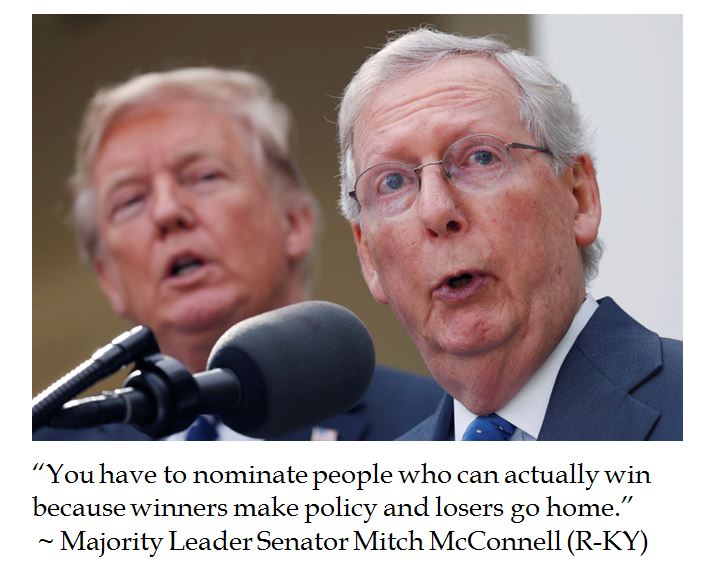
Majority Leader McConnell battled the Bannon fodder by suggesting that the way to win in Washington is to choose the right candidates, rather than achieve legislative accomplishments for a President in the same party.  McConnell called to mind the Tea Party boomlet in 2010, in which insurgents like Sharron Angle (R-NV) and Christine O'Donnell (R-DE), who upset GOP establishment candidates but who lost in the end.  Of course, these Tea Party insurgents did not get strong assistance from the national Republican Party and faced hostility from prospective colleagues like Senator John McCain.


Tuesday, September 12, 2017

On Celebrity Candidates and Whether Stephen King is It for Maine’s Governor

Ex Maine Gov. John Balducci renews Draft Stephen King campaign

Recently, former Governor John Baldacci (D-ME) has revived an effort to draft home state author extraordinaire Stephen King to run for the top post in Maine.  Aside from King’s celebrity status, the best-selling author has running grudge with the incumbent Governor Paul LePage concerning a quip that the writer left the state to avoid income taxes.  Even though King issued a Shermanesque denial of candidacy in March 2017, Democrat partisans still are seeking to draft him for Governor in 2018..

There have been some successes in celebrities turned into politicians. Obviously, President Donald Trump (R-NY) gained fame by parlaying his realty mogul status into a starring role in The Apprentice and Celebrity Apprentice before successfully running for the White House in 2016.  

President Ronald Reagan (R-CA) was a “B” movie star in the 1950s and corporate spokesman in the 1960s and was elected President for two terms in 1980. 

While both Reagan and Trump got a leg up from their celebrity status both in name recognition and fundraising potential, they were outsider candidates who rallied on reformist political platforms. Reagan espoused a Western brand of conservatism, which sought to cut the size and scope of government and live up to constitutional principles.  Trump identifies more with nationalist populism and an impetus to “drain the swamp” between the beltways to “Make America Great Again”.  Reagan was more committed to a conservative philosophy than Trump seems to adhere to a strict ideology, but both challenged their party to go in different directions.  


There have been some other recent cases of celebrity candidates.  Senator Al Franken (D-MN) was a contributor on Saturday Night Live along with having a minor movie and radio career until he won an extremel close three way Senate race in 2008.  Despite his self publicity, it is dubious if Al Franken is a Giant of the Senate (2017), even tongue in cheek.


Minnesota has a knack for electing celebrity politicians as Gov. Jesse Ventura (Reform-MN) was a professional wrestler before winning a three way election in 1998.  But Ventura was an outsider candidate who had several years experience being mayor of a Minneapolis suburb. 


In the recall special election to replace Governor Gray Davis (D-CA), Arnold Schwartznegger (R-CA) won the Governorship of California in 2003 against 134 other candidates. So clearly celebrity status helped in that special election, but star status did not boost all celebrities as Gary Coleman's and porn star Mary Carey's campaigns were for naught.   Schwartznegger served two terms as the "Gubernator".


Music sensation Kid Rock seems to be seriously flirting with running for Senate in Michigan in 2018.  Partisans are taking a Kid Rock candidacy so seriously that the Rev. Al Sharpton sought to have Kid Rock’s concerts inaugurating Little Caesar’s Arena to be cancelled as Sharpton's group vituperatively charged that the singer was dog whistle white supremicist. 

Although they have name advantage, celebrity candidates do not always pan out well. Consider the case of Ashley Judd, who took a leap into partisan politics skewering Senator Rick Santorum (R-PA) over abortion during the 2012 Presidential campaign. Judd seriously flirted with running for Senate against Senate Majority Leader Mitch McConnell (R-KY) in 2014. But Judd opted against the run after the Democrat establishment made it clear to her that  combination of being inexperienced as well as being too liberal and anti-coal doomed her candidacy.

There have been some sports stars who have parlayed their celebrity status into electoral success, such as Congressman Jack Kemp (R-NY 31st, 38th, 39th), Rep. J.C. Watts (R-OK 4th) and Senator Jim Bunning (R-KY).  But all of the aforementioned officials got their start in the House.  

Being in the media also has launched some political careers, such as Congressman J.D. Hayworth (R-AZ 5th) and Senator Jesse Helms (R-NC).  Radio hosts tend to form a bond with their listeners but those on television tend to have more exposure.  The challenge for celebrity candidates is to connect with voters by compelling keeping on message and guarding against exploitable unscripted moments.  Thus it is easy for Ashley Judd to appear in anti-pro-life ads against Santorum but how does she react when her life is an open book and there is not someone off-stage feeding her lines.  Or in King’s case, he is adept at taking pot shots against his bete-noire LePage but how does he sound on the stump if that is his predominant schtick? King is a good public speaker with a friendly audience but he might sound prickly with unfriendly audiences.

It is uncertain if the 69 year old King will back away from his Shermanesque refusal to run. However, Democrats are concerned about the 2018 cycle. In the Senate, Democrats have 24 of 33 seats up in 2018 with 10 vulnerable incumbents.  In the states, Republican have 34 of 50 governors’ mansions.  

It seems that Democrats see an opportunity to gain another statehouse against a weak incumbent Governor. Gov. LePage has a 47% favorable to 48% unfavorable rating so party insiders might think they could pick up a win with King.  And having a high profile governor, even of a small state, would be useful as the national Democrat leadership fights it out as to who will lead them in the 2020 election.  Along with being cajoled from Maine Democrat movers and shakers to run, King might also be swayed by that old typing exercise: “Now is the time for all good men to come to aid of their party.”