Showing posts with label Harry Reid. Show all posts

Saturday, July 7, 2018

Considering SCOTUS Selection Strategies


Associate Justice Anthony Kennedy's retirement at the end of the 2017/18 Supreme Court term affords President Trump another opportunity to fill a seat on the Nation's High Court.   After the Borking of President Reagan's first choice in 1987, the confirmation process is no longer a gentile process of Senate vetting whether the President's choice is qualified.  While the vacancy is still up in the air, it is a fun political junkie parlor game to consider the strategies the President Trump may employee to make the nomination. Major factors include: timing; traits; temperament

I.  Timing

Firstly, there is a question of timing.  Democrats have been braying that there should be no confirmations until after the midterm elections.  They point to how President Obama was denied an opportunity to replace the Scalia vacancy with Merritt Garland as Republicans refused to confirm just before an election.  Of course, their objections are ahistorical, as Kagan was confirmed thee months before midterm elections.  But when do fact matter to partisans who talk out of both sides of their mouths to gain advantage?  The difference in 2016 is that Republicans were in the majority and set the agenda.

Some partisans focused on the political horse race postulate that it might make sense to hold the confirmation until after the midterms to have Trump supporters Get Out The Vote (GOTV).  Such a strategy is needless and short sighted.   While our elected officials do not work in a vacuum so they need to be mindful of elections, the decision should not be primarily driven by political advantage. However, the deferral of confirmation in 2016 was a prudential decision by Senate Majority Leader Mitch McConnell (R-KY) to let voters decide. This move respected a 73 year old tradition for about Supreme Court openings in the last year of a Presidential term.

If one looks through a partisan lens, it makes little sense to stall the confirmation until after the midterms. Republicans have a majority in the Senate.  Thanks to ex Democrat Majority Leader Harry Reid (D-NV) blowing up comity in the Senate by exercising the Nuclear Option in 2013 and Democrat Majority Leader Chuck Schumer (D-NY) leading a Supreme Court confirmation filibuster in 2017, cloture votes are obviated and a only a majority vote is required.   While Senate Democrats have a hard midterm election cycle, one never knows what the future holds, so it would be better to try to get it done sooner rather than later.

Summers in the District of Calamity are often the silly season as political news is either trivial or outrageous, but typically few people pay attention as they are on vacation. Democrats are intent on fighting any Supreme Court nominee from President Trump tooth and nail, so the expected vitriol and direct action will not have as much resonance as it would be if it became a campaign issue.

If President Trump did not have a booming economy or positive news from foreign relations, it might make sense to make a SCOTUS nomination a campaign issue.  But George Barna pointed out through polling of evangelicals about the 2016 election, the two issues which that 11% segment of the population cared most about was the Supreme Court and pro-life positions.  Evangelical turned out 98% in 2016 and 96% voted for Trump, so there is little reason to gin up that base over a Supreme Court nomination.

It seems pretty clear that the nomination of Trump's second Supreme Court choice will be sooner rather than later.  During the 2016 Presidential election campaign, Mr. Trump had circulated a list of twenty five jurists who would be considered.  This list was augmented with five names after his inauguration which included now Justice Neil Gorsuch.

The White House indicated that it will announce the President's choice before he flies to Europe on July 10th. In fact, two days after Kennedy announced his retirement, President Trump announced that he had winnowed the frontrunners to five, including two women and set the selection announcement on July 9th.  So we will not play this Between the Beltways parlor game for long.

Moreover Majority Leader McConnell proclaimed that there will be a vote for confirmation by October.  This is in keeping with Senate Judiciary Chair Charles Grassley's (R-IA) timeline that from nomination to confirmation vote, the Senate could do its work in 78 days.

II. Traits

A Supreme Court nomination is one of the marquis decisions during a President's time in the Oval Office. The pick stays on the High Court long after the Chief Executive leaves the White House.  The fact that it is Justice Kennedy's replacement is even more significant.  Even though Kennedy was appointed by President Ronald Reagan in 1987, he has been a swing vote in his 31 years on the Supreme Court.  So Mr. Trump's choice will significantly impact the balance of power on the High Court.

At a campaign rally in Minnesota, President Trump mused that his choice could be on the bench for forty years.   Many of the jurists on the list are in their 40s and 50s so it seems that prospective longevity on the Supreme Court is an important attribute.

Does race or gender matter?  Perhaps.  Other Presidents have tried to make their mark by appointing "the first" identity group (e.g. Johnson with the first black of Thurgood Marshall in 1967, Reagan with the first woman Sandra Day O'Connor in 1982, Obama with the first Hispanic with Sonya Sotomayor in 2009). 

Trump is not likely to bow to political correctness or play identity politics.  Still, with 40% of Trump's short list being comprised with women, selecting a female could put vulnerable Democrats in a difficult position.  Prominent Democrats (and their media allies) have been strident in seeking to savage any pick made by President Trump.  There are already ten Senate Democrat incumbents in states where President Trump won in 2016 who have tough re-election races.  If these vulnerable Democrats are associated with an unjust evisceration of a female Supreme Court nominee, this may play very poorly for them during the midterms with key groups (suburban Moms, traditional Democrats, Independents).

Because of the timing of the selection, President Trump may want to ensure that the background vetting of a prospective nominee is speedy.  That might give an advantage to candidates who have recently been confirmed, as they have fresh FBI full field background investigations. So when speculation draws to a fevered pitch, consider who has been recently appointed to the federal bench.

III. Temperament


Despite contradictory indications during the 2016 primary campaign, President Trump has proven to be a Pro-Life President.  Yet he maintained that he will not ask about abortion when he interviews his short list.  This is hardly surprising because a good Supreme Court candidate will wisely deflect such a probing question, pointing to not answering hypothetical questions or not tipping one's hand on pending matters.  As the left has made abortion rights a keystone issue, much of the pre-nomination hysteria revolves around the potential overruling of Roe v. Wade (1973).  Any prospective candidate for the nation's High Court needs to be prepared for hard questions from the Senate Minority.

This points to a couple of qualities which Supreme Court nominees need to possess at least through confirmation.  A SCOTUS choice must be prepared.  Harriet Miers was a failed choice of President George W. Bush, in part, because she was not impressive in constitutional chit chat with Senate Majority members when making courtesy calls.

To present well in the Senate Judiciary Committee, successful candidates must master "Murder Boards",  that is the harsh mock interviews preparing for the hard questions.  Once they are on the bench, Supreme Court members deliberate in private.  But before confirmation, they must skillfully parry with hostile questions, which generally do not tip the hand of a prospective justice yet sufficiently satisfy the interlocutor. 

For a contentious candidate, mouthing the mantra "I can't comment on a prospective matter" or "Courts adjudicate real cases and I do not comment on hypotheticals" will not suffice.  As Roe v. Wade will mostly likely be touchstone for skeptical questioning, whoever is nominated must be well prepped to answer questions about "the right to privacy" and the primacy precedence (a.k.a. stare decisis).

When John Roberts went through his confirmation hearings, he did not totally deflect about questions of precedence, noting that there are some instances of bad precedence that should be upheld (like "Separate but Equal" Plessey v. Ferguson in 1896 which was overturned in 1954 by Brown v. Board of Education).


Nominees also must be mindful how simple questions can be abused by opponents to their confirmation.  When Judge Bork was asked why he looked forward to being on the High Court, and Bork answered that it would be an intellectual feast.  That answer was twisted to portray Bork as being an elite intellectual who was only in the position for himself.  Combined with vilification of Bork's record by liberal Senators, chiefly Ted Kennedy (D-MA), the nomination was defeated. 


While Supreme Court candidates should be sufficiently deferential to tough questioning, sometimes they can successfully fight back.  The left tried to "Bork" Clarence Thomas in 1991 with allegations about a subordinate employee Anita Hill.  Thomas famously refuted his treatment as a "high tech lynching of an uppity negro."  Despite that contentious quip, Thomas was narrowly confirmed.

As for judicial temperament, President Trump's list of 30 prospective selections, prima facia most would be deemed conservatives.  But their legal logic is not necessarily uniform.  Justice Thomas's jurisprudence rests on "natural law", whereas Justice Gorsuch is a textualist who looks to the letter of the law  which defers to the will of the legislature (even if they pass stupid laws).  Then there is originalism, which sees things through the prism of an understanding of the Constitution when it was originally ratified. 

A judicial trait which seems to be in favor with President Trump is the notion of judicial humility.  


Former Judge Andrew Napolitano characterizes this jurisprudence to interpret the law and apply the Constitution to the laws Congress has written. Judicial humility has not been the prevailing model of Supreme Court activism over the last sixty years, with the High Court legislating from the bench by inventing rights (e.g. "The Right to Privacy") or rewriting law to rule it constitutional (e.g. "Obamacare").

Since the Kennedy retirement has been announced, there has been rampant speculation about Mr. Trump's picks.  Even though the President has interviewed seven prospective SCOTUS picks, it has been generally considered that the list has been narrowed to four candidates.  Some even say that there are just two front runners.  Senator Orrin Hatch stirred up the rumor mill when he stated in an Op/Ed that he will fight for Mr. Trump's pick.  But some wonder if he had insider information, as Hatch's release  opined


"But no matter the nominee's background or credentials, progressives will do everything they can to paint her as a closet partisan, if not an outright extremist."

This could well be a MacGuffin to throw off all speculation, a ghostwriter using inclusive language or a retiring Senator tipping the hand. If Hatch was not just being deceptive or politically correct, there is only one female on the short list of choices, Judge  Amy Coney Barrett, who made headlines when Senator Diane Feinstein rebuked her by saying: "The [Catholic] dogma lives loudly within her" during her September 2017 confirmation hearings.   If President Trump is raring for a fight, picking Barrett could paint Democrats as being bigoted towards Catholics, and hint that Roe v. Wade might not stand.  But considering the vitriol which Democrats have been displaying and the importance that they place on abortion rights, this may also be a dangerous donnybrook.

One thing can be said with certainty -- the Simpsons were being satirical rather than sagacious with their rending of a Trumpian Supreme Court pick.


Ivanka will not be sporting a black robe (in public) anytime soon. 


Thursday, June 28, 2018

On Applying the Nuclear Option and Comity


Article II Section 2 of the Constitution gives the United States Senate the prerogative to give "Advice and Consent" in confirming Executive Branch nominations, especially the judiciary. For most of the Republic, confirmations of Supreme Court justices were not voted on in a markedly partisan manner. 

The Senate, which liked to consider itself as the world's greatest deliberative body, usually operated in a manner which vetted high court nominees in a conscientiously deferential manner to the President.  For example, Ruth Bader Ginsburg had been chief counsel of the ACLU and a noted feminist attorney, yet she garnered a 93-3 confirmation vote in 1993. 


Admittedly, this was not always the case. President George H.W. Bush's nominee of Clarence Thomas endured a contentious confirmation hearings  in 1991 which he likened to a "high tech lynching for uppity blacks".  

And  of course the vitriolic attacks on Robert Bork, President Ronald Reagan's 1987 pick to fill a Supreme Court opening, resulted in the verb "to Bork" to be added to the Oxford English Dictionary in 2002.  But the adamant opposition from the left stemmed, however peripherally, to nitpicking "flaws" in the nominees.

Much of the comity that the Senate enjoyed was due to Cloture Rule (Senate Rule XXII) which was instituted in 1917.  In order to end debate on a filibuster, three-fifths of Senators (today 60 votes) is required.  Applying that to judicial nominees, Presidents often picked less stridently partisan or controversial candidates, as some Senate Minority votes were needed in order to advance to the confirmation vote.  


Former Democrat Senate Majority Leader Harry Reid (D-NV) found this 3/5ths Cloture requirement to be inconvenient in his effort to aid President Barack Obama in packing the judiciary (particularly changing the balance in the 4th Circuit, a.k.a. "The Rocket Docket").  Thus, in 2013 Reid exercised "The Nuclear Option" which abrogated Senate Rule XXII for judicial confirmations save Supreme Court nominees. 


 Reid was warned on the Senate floor by then Republican Senate Minority Leader Mitch McConnell (R-KY) that you will regret using the nuclear option.   In the 115th Congress, when Senate Democrats became openly obstructionistic about any nominations made by President Donald Trump, Majority Leader McConnell extended the "nuclear option" to include Supreme Court nominees, which resulted in Neil Gorsuch being confirmed by a 54-45 vote.


After Justice Anthony Kennedy's announced retirement from the Nation's High Court, Democrats have campaigned for the Senate to delay confirmation hearings for the SCOTUS opening until after the 2018 midterm elections.  Their facile rationalization is that Republicans ought to follow the same standard used to deny Merritt Garland a confirmation hearing in 2016 because it was an election year.  Of course, this partisan plea ignores that it was a Presidential election year and had over 70 years of precedent.  In addition, Democrats are not in the majority and they set the agenda. Elections do have consequences.  

So does changing and exploiting rules.  Democrats might have some gravitas to their suggestion to stall SCOTUS confirmation hearing until after the midterms if they were not already slow walking nearly all Trump confirmations.   Senate rules allow for 30 hours of debate on each nominee.  Democrats have been routinely requiring the entire 30 hours of debate, which would mean that President Trump's picks could receive senatorial "advise and consent" in nine years. So the threat that Democrats will further slow walk Senate proceedings in retaliation or to forestall a SCOTUS confirmation vote is meaningless. 

The recalcitrant response of Democrats should be a cue to Majority Leader McConnell on how to react to the diminution of comity in the Senate.  If Democrats are going to slow walk everything in retaliation or retribution for the Senate leadership for exercising their "advice and consent" on Supreme Court nominees in a timely manner, then keep them in session.  McConnell already effectively cancelled the traditional long summer recess so they can meet their budgetary duties. So they get to spend the dog days of summer on Capital Hill and enjoy the swampy weather in the District of Calamity (sic).


But the lack of comity and the need for elected officials to do their job might mean spending more time on Capitol Hill.  Since Democrats seem to relish filibusters and slowing the process down, the Majority Leader should change how filibutsters are treated.  Instead of the failure of a cloture vote resulting in the legislation (or the nomination) being pulled, let the debate continue.  If legislators want to invoke "Mr. Smith Goes to Washington" and talk until they are hoarse and drop from exhaustion, that is their prerogative.  But just as the nuclear option changed things in unexpected ways, tinkering with the filibuster might have adverse effects on Senate minority rights in the future.

Moreover, so that the Senate is not simply the place where legislation goes to and dies, remain in session through October instead of taking the election break.  From an objective standpoint, they will be doing their jobs (instead of concentrating on getting re-elected).  Politically, this hurts Senate Democrats (as they have 25 of 33 seats up, including 10 in states where Mr. Trump won).  And it might make obstructionism less appealing and allow incumbents to give comity a chance.


Tuesday, March 7, 2017

Primary Concerns for Democrats Supporting Gorsuch Cloture Vote


Now that they are relegated to minority political status in the District of Calamity, the progressive wing of the Democrat party feel free to impose purity tests and try to effectively take over the party.

One of the litmus tests for a Senate Democrat to show their loyalty towards liberalism is to oppose President Trump's choice for the Supreme Court, Judge Neil Gorsuch.  


Senate Democrats may stew over a "stolen" SCOTUS pick, because the Senate Majority in the 114th Congress refused to hold hearings and scuttled former President Obama's lame duck Supreme Court pick Merrick Garland. This Senate Advice and Consent through inaction followed a 70 year precedent of not confirming SCOTUS picks in the last year of an Administration so as to let voters decide.

However some Democrats are so obstreperous that they will not meet with Judge Gorsuch, like Senate Minority Leader Chuck Schumer (D-NY).  Those who consented to meet Judge Gorsuch have been charmed by him and his impeccable legal credentials.

Liberal advocacy groups like Credo Action felt emboldened by Schumer's antipathy approach thus they warned wavering Senate Democrats that if they so much even consented to a Cloture vote for Judge Gorsuch that they will face primary opposition in the 2018 cycle.

Heidi Hess of liberal advocacy group Credo Action threatens any Democrats voting for Gorsuch Cloture vote will be primaried

So Democrats opposed Republicans effectively filibustering Garland through a no vote yet they want to do the same thing to Judge Gorsuch.  As Chris Plante is wont to say, if it wasn't for double standards, liberals would not have any at all.  Ironically, filibustering will be futile thanks to the legacy of  former Senate Majority Leader Harry Reid (D-NV) who invoked the nuclear option in 2013.  Now all the current Majority Leader Mitch McConnell (R-KY) needs to do is expand the rule change in medias res to include Supreme Court nominations. 

From an objective standpoint, Democrats threatening to primary vulnerable Senate Democrats to just allow a vote for a Supreme Court Associate Justice seems counter-intuitive.  The Scalia replacement would not drastically change the balance of the court, so why come out with guns blazing against your own for a goal which is note a game changer.  

Although Democrats only need to garner three net seats to regain control of the Senate, they face a tough election cycle in 2018 with 23 of 33 seats up.  Incumbents have a much easier time fund raising and winning general elections, so why take out your own (even if they stray from the party line on some issues)?  Furthermore, ten of the Senate races are Democrats in states that voted strongly for President Trump.  Threatening to primary Democrat incumbents pushes them further to the left, which was not were the vox populi seems to be in those states.

If opposition from the left seems too strident, some incumbents like Senator Joe Manchin (D-WV) and Senator Heidi Heitkamp (D-ND)  might conclude that the grass is greener on the other side of the aisle. Even if they do not politically defect, they may be emboldened to vote their conscience to keep their integrity or burnish their independence from a progressive purge to keep their seat.

It would seem prudent for progressives to not play hardball on this Supreme Court nomination but fight like hell if a senior liberal Associate Justice (like 83 year old Ruth Ginsburg or 78 year old Stephen Breyer) or majority maker 80 year old Anthony Kennedy decided to retire.  But it seems that progressives do not want to leave any powder in reserve for such a contingency.  

Even though objections to the Scalia replacement were packaged as being objections to Garland's no vote or automatically opposing President Trump's pick, it seems that progressives are concerned that reversing Roe v. Wade and throwing the adjudication of abortion back to the states is at stake. 

Tuesday, January 31, 2017

Smart SCOTUS Oppo Strategerie (sic)

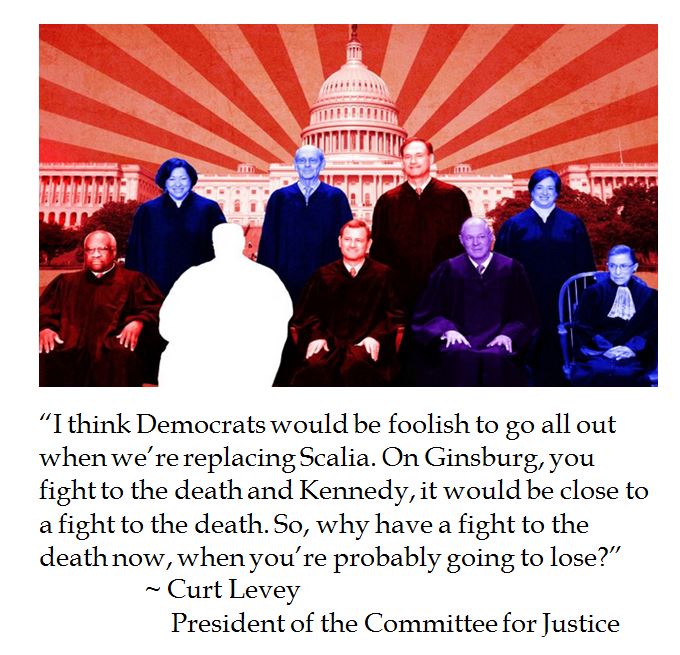
Curt Levey on Smart Strategy to Fight Trump's Supreme Court Picks


As sagacious of a strategist Committee for Justice President Curt Levey may be, it seems that Democrats in the District of Calamity have taken a different tact.

Senator Jeff Merkely (D-OR) has declared that there must be payback for the 114th Congress not approving lame duck former President Obama's pick of Merrick  Garland.  Senate Minority Leader Chuck Schumer )D-NY) has declared that he will not work with President Trump unless he utterly does the Democrats' bidding.

In years past, protestations of non-cooperation might have caused Senate Republicans to buckle and moderate.  But thanks to former Senator Majority Leader Harry Reid (D-NV) and the Reid Rule, cooperation for cloture on appointments is now moot.

Democrats may bluster that only needing a majority was not intended to be for Supreme Court nominees, but that is after the fact dicta.  Per Hugh Hewitt and Senator Ted Cruz (R-TX), the Reid Rule is about the Senate only requiring a majority to change the rules mid-session. Besides, Reid himself intimated that he showed his Democrat Senate colleagues how to steamroll the GOP with this rule, even for High Court picks Even liberal Senator Chris Coons (D-DE) admits that the filibuster is no longer an emergency brake on nominations.

Under normal circumstances, a newly elected President has little opposition to his first Supreme Court nominee, especially early in his first term.  But these are not ordinary times.  Democrats are wont to hyperventilate about anything that the Trump Administration does, and seem happy to escalate any altercation to the extreme.  Democrats have sought to slow walk Trump Administration confirmation hearings, going so far as to not show up at Senate Committee Hearing votes.

Senate Majority Leader Mitch McConnell (R-KY) has been chary to confirm that Republicans will invoke what was once called "the nuclear option", but he has been steadfast in assuring the public that Trump Administration will be confirmed.  The same is true regarding  President  Trump's pick for the Supreme Court.

The danger that Democrats have in protesting so vehemently to everything in the early Trump Administration and calling supporters out to the ramparts is three fold.

 First, they risk over-exhausting their partisans.  You can only cry "the sky is falling" only so often before it loses its desired effect.

Secondly, Democrats are not picking their battles wisely.  It is not only the incoherence of opposing everything, but in going to the mat for losing causes.  Because of the Reid Rule, President Trump will get his Cabinet appointments and most likely the first Supreme Court pick.  By fighting so hard on the nominations, it may serve to demoralize their partisans.

Thirdly, the hyperventilating opposition may play well for the progressive base of the Democrat Party but it may serve to alienate white, working class Democrats who voted for Trump in 2016 on positions and personnel with which they agree.

Historically, Democrats do not turn out in mid-term elections.  In the 2018 election cycle, Democrats have 23 seats up in the Senate, including in states which voted for Trump.  Such strident opposition, epitomized by an obstructionist approach to Trump's first Supreme Court pick (even before he is announced) may solidify a one time "what have you got to lose" vote to a realigning "my party has left me" metanoia, thereby making  Blue Dogs and DC Democrats politically endangered species

Thursday, January 5, 2017

The Legacy of Dirty Harry and the Reid Rule on Senate Filibusters

Harry Reid on SCOTUS nominations

A legacy of former Senate Majority Leader  Harry Reid (D-NV) was the effective elimination of the confirmation filibuster.  

Under the Constitution, it is the Senate's duty to confirm Executive and Judicial Branch appointments.  Senate rules allowed for confirmations with mere majorities, but needed to obtain 60 votes to cut off debate (Cloture) and preclude a filibuster.  The Cloture vote was intended to prevent endless obstructionism while still giving the minority some say in the proceedings of the Upper Chamber of Congress.

Needing to get enough votes for cloture was an incentive for Republicans to select more moderate appointees which required Senate consent.  But such Senate niceties stopped political steamrolling by Majorities who wished to exercise their unadulterated will.

When the Obama Administration sought to pack the Court of Appeals for DC (aka the DC Circuit), which is the court of authority for regulatory bodies, it ran into trouble when its candidates might not have received the requisite support for a Cloture Vote.  So then Senate Majority Leader Harry Reid, exercised "The Nuclear Option".  Exercising the Nuclear Option had been hotly debated in the preceding decade, but then Senate Majority Leader  Bill Frist (R-TN) opted not to circumvent tradition. 

Through Parliamentary legerdemain, Reid established a precedent in which he said that all judicial nominees, save Justices of the Supreme Court, would be considered on majority votes and did not have to pass the Cloture Vote threshold.  

The Reid Rule was great when one's party is in control of the Senate and the White House. But in 2017, President Donald Trump will occupy the White House and Republicans have a two seat majority in the Senate.  Incoming Senate Minority Leader Chuck Schumer thinks that he can stymie the Trump Administration through the advice and consent clause as well as any Supreme Court nominations which do not represent progressive Democrat values.  However, Schumer may well rue the Reid rule legacy from Dirty Harry Reid. 

Senator Ted Cruz (R-TX) and Salem Radio host Hugh Hewitt had an informative colloquy on the Reid Rule.


 Republicans may not moderate their choices for positions which need to be confirmed by the Senate.  Despite Harry Reid's contention that the "Reid Rule" excludes Supreme Court nominees, it is contented that avoiding Cloture for a Supreme Court nomination would simply be a second application of the Reid Rule precedent.