Some consider the Nation’s Capital as “Fantasyland on the Potomac”. Other outsiders are “Fed Up” with the Federal City. It's better to consider D.C. as “the District of Calamity” (sic).
The National D-Day Memorial is located in Bedford, Virginia. This site in in the Blue Ridge Mountains in rural southwest Virginia was chosen because it was the community the suffered the most per capita D-Day losses in the nation.
There were 150,000 Allied troops that landed on the heavily fortified beaches of Normandy, including 34 troops from Bedford. Of the 9,000 killed and wounded during the D-Day invasion, 19 of the Boys of Bedford paid the ultimate price to preserve freedom and four more died later during the Normandy campaign.
The National D-Day Memorial was dedicated on June 6th, 2001 by President George W. Bush. America's 43rd Commander-in-Chief implored:
"Fifty-seven years ago, America and the nations of Europe formed a bond that has never been broken. And all of us incurred a debt that can never be repaid. Today, as America dedicates our D-Day Memorial, we pray that our country will always be worthy of the courage that delivered us from evil and saved the free world."
The National D-Day Memorial honors by name all 4,413 Allied soldiers who died on D-Day during Operation Overlord (the actual invasion) and Operation Neptune (transporting the troops across the English channel). But the 88 acre National D-Day Memorial does much more serve as a site for necrology. The Memorial seeks to tell the story of D-Day , from its planning, execution and aftermath.
The first Plaza is a stylized English garden symbolizes the planning and preparations for the greatest amphibious invasion in history. The Reynolds Garden is dedicated to the visionary industrialist who forsaw America's need for aluminum. In the late 1930s, Richard Reynolds put his fortune and reputation on the line to provide enough aluminum for the United States to build and sustain the air force that gave the Allies overwhelming air superiority for the retaking of Europe on D-Day.
The plaza is in the shape of the Supreme Headquarters Allied Expeditionary Force combat patch. Following British Prime Minister Winston Churchill's sense of history and drama, the invasion code name was Overlord, evoking crusader knights and chivalric quests, the SHAEF insignia features a crusader shield with a flaming sword of expulsion.
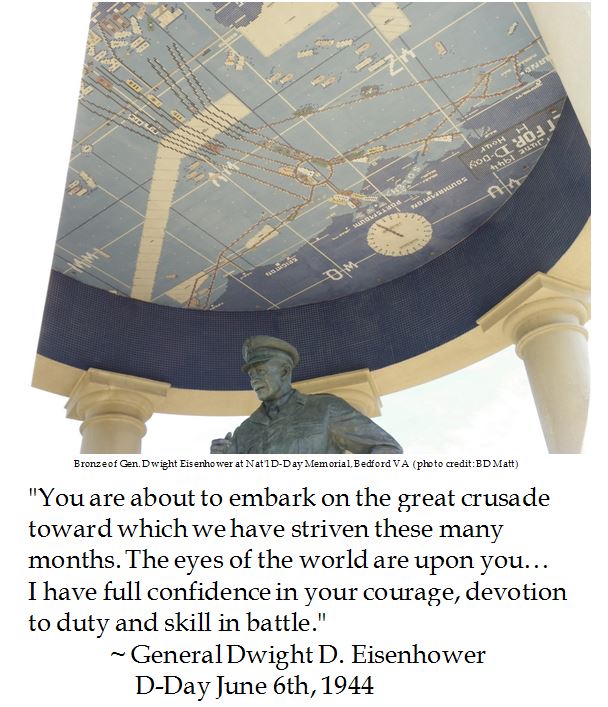
The Reynolds Garden is peaked by a domed Tuscan folly with a full figured bronze of General Dwight Eisenhower standing below a canopied mosaic of the D-Day battle map. This classical revival feature recalls the architecture of Southwick House, where Ike decided to launch the invasion despite less than ideal weather.
The parameter of the plaza also includes busts of the six Allied Generals who were involved with D-Day invasion: Air Chief Marshal Tedder, Air Chief Marshal, Leigh-Mallory, Admiral Ramsey, Field Marshall Montgomery, Lt. General Omar Bradley, and Lt. General Walter Smith.
Circle of Generals involved in Allied D-Day Invasion, Reynolds Garden, National D-Day Memorial [photo: BD Matt]
The next level is Gray Plaza is an assault tableau which depicts the landing and fighting stage of the invasion. Across the Beach (includes an invasion pool with beach obstacles in the water, a Higgins invasion craft and sculptures of soldiers struggling to get onshore. The names of the American fallen appear on the western walls of the central plaza while the rest of the Allied losses are on the eastern wall.
Soldier under fire detail of Across the Beach (2008) by Jim Brothers at National D-Day Memorial [photo credit: BD Matt]
Across the Beach tableau (2008) by Jim Brothers, National D-Day Memorial [photo credit: BD Matt]
Across the Beach tableau (2008) by Jim Brothers, National D-Day Memorial, Bedford Virginia [photo credit: BD Matt]
POV from Higgins boat, Across the Beach (2008) tableau by Jim Brothers, National D-Day Memorial
Scaling the Wall , National D-Day Memorial, Bedford, Virginia
[photo credit: BD Matt]
Detail, Scaling the Wall (2001) by Jim Brothers, National D-Day Memorial, Bedford Virginia [photo credit: BD Matt]
There are also airplanes which represent the importance that air power had in the Allied invasion.
Representation of Aircraft used on June 6th 1944, National D-Day Memorial, Bedford, Virginia
Propellers from D-Day era aircraft, National D-Day Memorial, Bedford, Virginia [photo credit: BD Matt]
The upper level is the Estes Plaza which is dominated by Overlord Arch which is flanked by the twelve flags of the Allied Expeditionary Force. The Arch stands 44 feet and six inches tall.
Honor Guard practicing before D-Day ceremonies, National D-Day Memorial
Valor, Fidelity Sacrifice Bronze by Jim Brothers (2001) and Overlord Victory Arch at D-Day Memorial,
Bedford, Virginia [photo credit: BD Matt]
Valor, Fidelity Sacrifice Bronze by Jim Brothers (2001), National D-Day Memorial, Bedford, Virginia [photo credit: BD Matt]
The planners of the National D-Day Memorial had not forgotten the horrors of war along with the valor, fidelity and sacrifice of Allied troops. The final section of the National D-Day Memorial includes a haunting bronze of Edmond de Laheudri's Le Monument aux Morts (1921), which stood monument to those fallen in combat in the Great War (a.k.a. World War I) besides St. Aignan in Trevieres, France. Shortly after the Allied D-Day invasion, there was an intense battle around the statue during which removed the face and some of the fingers of the dough-boy Nike.
Recast bronze of Le Monument aux Morts (1921) by Edmond de Laheudri,
National D-Day Memorial, Bedford, Virginia [Photo credit: BD Matt]
Transformed by battle, Le Monument aux Morts stands in Trevieres and at the National D-Day memorial as a haunting testament to the destructiveness of war, the fleeting fruits of victory and the fragility of peace.
Brronze of Le Monument aux Morts (1921) by Edmond de Laheudri, National D-Day Memorial, Bedford, Virginia [Photo credit: BD Matt]
Inverted M1 Garland Rifle bronze by Matt Kirby (2001) at National D-Day Memorial, Bedford, Virginia
The National D-Day Memorial's attempt to tell a broader story about the Second World War caused some controversy. As the Reynolds Garden is circled by the military leaders of D-Day, the planners wanted to include a garden which depicted political leaders after D-Day who ensured the peace after World War II. The circle included President Franklin Roosevelt (who died shortly before V-E Day), British Prime Minister Winston Churchill (who was ousted from office shortly after victory over Germany), President Harry Truman, Prime Minister Clement Attlee, French leader Charles De Gaulle and Soviet Premier Joseph Stalin.
The latter bust went over like a lead zepplin with veterans' groups as Stalin had no involvement with the Allies in the Western front and arguably triggered the Cold War with forceful imposition of communism in most places where the Red Army occupied. While the National D-Day Memorial board still believed that war makes strange bedfellows and wanted to depict that within the site, they bowed to public pressure and relocated the Stalin bust. Perhaps when the interpretation center is completed with a monument to post World War II Secretary of State George Marshall, there will be a fuller picture of the interpreted history. For now, Stalin is not in "The Winner's Circle". However, based upon the horrors depicted in the transformed Le Monument aux Morts, it is questionable if anyone is truly a winner in the aftermath of war.
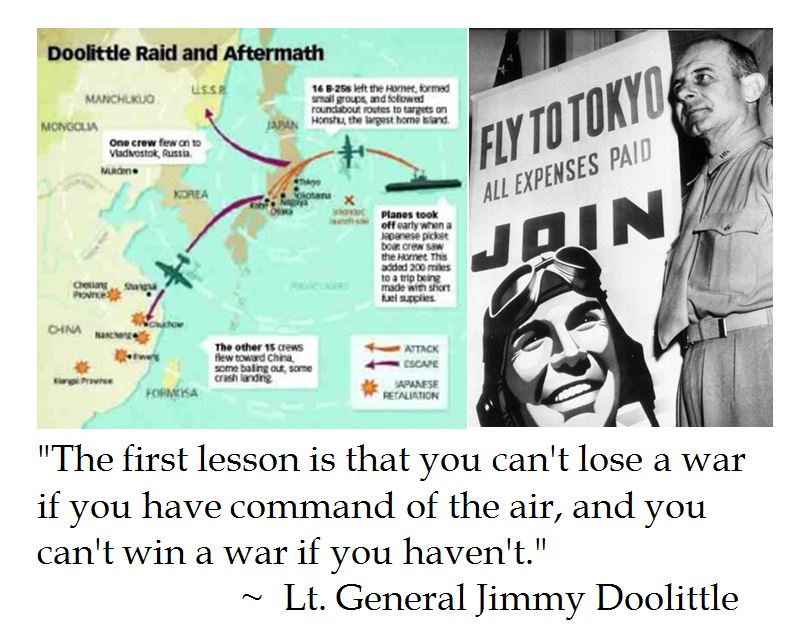
Just a little over five months after the devastating Japanese surprise attack on Pearl Harbor, the United States made a daring raid on the Imperial Homeland. The responsibility to conduct the raid fell upon then Lt. Col. Jimmy Doolittle, a revered test pilot for the U.S. Army Air Corps. Sixteen specially modified B-25B bombers carrying 80 men took off at night from the USS Hornet on April 18, 1942, which was positioned 500 nautical miles off the Japanese mainland. The plan had to be rushed as the Hornet was sighted further out than expected. The Army Airmen participating in Doolittle's raid understood that they were most likely on a suicide mission. Their intended targets were military and industrial targets in Tokyo, Yokohama, Kobe, Osaka, Nagoya and Yokosuka. One of the sixteen planes had to bail before it reached its target. Remarkably despite losing 15 aircraft, only four of eighty men were killed in the Doolittle Raid, eight became POWS (but three were executed), and one crew was interned after landing in Vladavostok, Soviet Russia. They were held in the USSR for a year and were "smuggled out" (probably arranged by the Russian Secret Police NKVD because the USSR could not release the prisoners because of the neutrality pact with Japan).
Doolittle expected to be court marshaled as his raid lost 15 of 16 aircraft in pin prick air strikes. But back in the United States, the daring Doolittle Raids was celebrated as a morale building first strike against Imperial Japan. The Japanese were caught off guard by the Tokyo Raid and the Imperial Military rearranged forces, which might have turned the tide in the Battle of Midway in June 1942.
Doolittle received the Medal of Honor from President Franklin Roosevelt, with the citation:
"For conspicuous leadership above and beyond the call of duty, involving personal valor and intrepidity at an extreme hazard to life. With the apparent certainty of being forced to land in enemy territory or to perish at sea, Lt. Col. Doolittle personally led a squadron of Army bombers, manned by volunteer crews, in a highly destructive raid on the Japanese mainland." Doolittle was eventually promoted as a Lt. General and became the highest ranking active reserve officer in modern times. Sometimes the bigger battle is won through morale boosting and reminding America of its mission.
Today in a ceremony in Manhattan, academics posthumously honored longtime Georgetown University professor Jan Karski, a man who tried to prevent the Holocaust by sharing the truth. Alas, politicians among the Allies were tardy to act of the news from Karski as the Messenger from Hell.
During the Second World War,I Karski was a Second Lieutenant in the Krakow Valvary Brigade who was captured after the battle of Tomaszow (1939) by the Russians. But due to Karski's birthplace, the Russians handed him over to the Germans, thus he avoided being a victim of the Katyn massacre of 1940. Karski escaped his German POW train in 1939 and escaped to Warsaw where he joined the Polish Resistance
movement. Larslo organized courier missions to the Polish Government in exile headquartered in Paris andhe himself made several secret trips to France and Britain. Karski was eventually
captured by the Gestapo and tortured in Slovakia but was later smuggled out and
rejoined the Polish Resistance.
In 1942, Karski was selected by Polish Prime Minister in exile Władysław Sikorski to go on a secret mission to gather first hand information about the Nazi atrocities in occupied Poland. Karski was smuggled into the Warsaw Ghetto. Karski also sought to infiltrate the Belzec death camp as an Estonian guard. Although Karski only managed to see a transit station, the horror that he witnessed first hand was appalling.
After briefing the Polish Government in exile upon his return to London in 1942, Karski met with other exiled Polish politicians and British Foreign Minister Anthony Eden about his first hand testimony about the Holocaust. In June of 1943, Karski traveled to the United States to personally brief President Franklin Roosevelt, as well as other American civic and government leaders, including Secretary of State Cordell Hull and Associate Supreme Court Justice Felix Frankfurter, without much effect. Karski published his recollections Courier from Poland: The Story of a Secret State (1944) which sold more than 400,000 copies.
Eventually Jan Karski settled at Georgetown University, eventually earning a Ph.D in 1952 and taught there for over forty years. Georgetown remembers Jan Karski as many things — a beloved professor, writer,
and colleague, to name a few — but to the world, he was known as one of the
first to warn Western powers of the horrors of the Holocaust.
Jan Karski at Yad Vashem (circa 1982)
Although Karski was a Roman Catholic, he felt a profound connection with the people whose lives he attempted to save from the Holocaust. In 1981, Karski said: “All murdered Jews
became my family. I am a Christian Jew.” In 1982 Karski was
recognized by Yad Vashem as Righteous Among the Nations.
In 1991, he received the Wallenberg Medal from
the University of Michigan for his outstanding humanitarian efforts. In 2012, President Barack Obama posthumously awarded Jan Karski the Presidential Medal of Freedom for his heroic witness to the ugly truth of the Holocaust. Mr. Obama proclaimed: "Jan Karski -- a young Polish Catholic -- who witnessed Jews being put on cattle cars, who saw the killings, and who told the truth, all the way to President Roosevelt himself."
"Whoever does not condemn, consents" mural in Warsaw
Karski's faithful witness has been remembered from murals in Warsaw to a series of five bronzes of Karski sitting on a bench playing chess created by Krakow sculptor Karol Badyna which are located in Georgetown, Manhattan, Lodz, Warsaw, Keilce and Tel Aviv University in Israel.

 The National D-Day Memorial was dedicated on June 6th, 2001 by President George W. Bush. America's 43rd Commander-in-Chief implored:
 The National D-Day Memorial honors by name all 4,413 Allied soldiers who died on D-Day during Operation Overlord (the actual invasion) and Operation Neptune (transporting the troops across the English channel). But the 88 acre National D-Day Memorial does much more serve as a site for necrology. The Memorial seeks to tell the story of D-Day , from its planning, execution and aftermath.


 The latter bust went over like a lead zepplin with veterans' groups as Stalin had no involvement with the Allies in the Western front and arguably triggered the Cold War with forceful imposition of communism in most places where the Red Army occupied. While the National D-Day Memorial board still believed that war makes strange bedfellows and wanted to depict that within the site, they bowed to public pressure and relocated the Stalin bust. Perhaps when the interpretation center is completed with a monument to post World War II Secretary of State George Marshall, there will be a fuller picture of the interpreted history. For now, Stalin is not in "The Winner's Circle". However, based upon the horrors depicted in the transformed Le Monument aux Morts, it is questionable if anyone is truly a winner in the aftermath of war.