Friday, April 13, 2012

Sharpton Draws Cross Comparisons

photo:/ David Shankbone
On Easter Thursday, the Reverend Al Sharpton made some cross comparisons between Jesus Christ and Trayvon Martin when he spoke before the National Action Network’s meeting in Washington, DC. Sharpton pontificated:

We believe in Jesus, they crucified him and never had a charge... They never charged, there wasn’t no crime on his indictment. So we’ve got to deal with the inequities of the criminal justice system. The fact that we (black people) are overly-incarcerated, the fact that we go to court and are treated differently, and the fact that when we’re victimized there is not the same response. That’s what Trayvon was about.


That’s extraordinary exegesis from the Reverend Sharpton. But Sharpton’s other pronouncements about Trayvon seem as provocative and pugnacious as the Lunacy in Luton. This tendency towards fusing intolerant theology with polemic politics is a trend that we should resist we much (sic).

Protesters in Sanford, Florida were disappointed that the Reverend Sharpton reneged on his promise to appear at a Pre-Easter Occupation for the slain teen. But Sharpton was not chanting with the Culture Club. Instead, the right Reverend was keeping it real as Sharpton spent Resurrection Sunday leaning forward on MSNBC panel.

No wonder Sharpton could make such cross comparisons.

Thursday, April 12, 2012

Keeping Politically Curious on Public Broadcasting


The Ninth Circuit Court of Appeals has struck down the ban on political advertising for public radio and television stations on a 2-1 vote.  But Judge Carlos Bea affirmed the ban on for profit companies advertizing goods and services.

The stated legal logic is:


Public issue and political advertisements pose no threat of ‘commercialization'..."Such advertisements do not encourage viewers to buy commercial goods and services. A ban on such advertising therefore cannot be narrowly tailored to serve the interest of preventing the 'commercialization' of broadcasting.

Be mindful that this is the Ninth Circuit, has a reputation of being the most overturned federal jurisdiction. But for this election cycle, prisoners of PBS might be praying for telethons rather than the onslaught of election ads.


In the abstract, this ruling may be a good thing for public broadcasters.  Conservatives have long felt that PBS and NPR slants markedly left in its coverage and sensibilities. It might be profitable for them to get paid for broadcasts.  But a close reading of the US Code indicates that public broadcast stations can not substantially relying on underwriting acknowledgments for funding their operations.

It might be interesting to learn how much underwriting spots cost, as it could be a cheap way for underdogs or even ideologically insurgent (read Republicans) to introduce their ideas to public broadcasting viewers. Of course, denial of political sponsors on public broadcasters could generate some earned media for campaigns as well as exposing the nearly translucent veil of impartiality by many public broadcasters.

While it is more of a political than an judicial issue, Minority Television Project v. FCC might spur a rethinking of the 1967 Public Broadcast Act in our information overload area and perhaps a retooling of the FCC itself by Congress. When there were only a few choices on the television dial, it made sense to have an alternative which supported niche programming.  Now cable, satellite, digital over-the-air multicasts and internet streaming offers an alluvia of choices for consumers.  In this changed media marketplace, it might make sense to rethink TV.

There are also some absurdities in Public Broadcasting.  It used to be that public broadcasters relied on the largess of wealthy individual underwriters (or their trusts) to sponsor favored programming like “Masterpiece Theater”.  Underwriting can now be done by corporations, but not to commercialize products.  So there tends to be warm fuzzy branding for the corporate sponsor, even with moving images-but no commercials (sic).  Really?

Public broadcasting is not a fledgling operation either.  Eighteen months ago, KCET in Los Angeles, one of the founding members of PBS in 1970, decided to become an independent public broadcaster because PBS wanted to charge $7 million a year for their West Coast flagship station’s broadcast rights, which was double the assessment of KOCE, This assessment comprised 5% of PBS overall budget.  The KCET executives may be ruing their decision to declare independence, as they had to sell their Hollywood Studios to the Church of Scientology for $45 million.  Alas, KCET’s new mixture of Al Jazeera English and BBC News has not helped, as contributions were down 41% in 2011.

When Juan Williams was unceremoniously fired by then NPR CEO Vivian Schiller, it was revealed that only 2% of National Public Radio’s budget came from federal earmarks.  If that's the case, then cutting Federal funding and allowing these public stations to establish alternate primary income streams should be simple.

Of course, this rosy budgetary situation for NPR greatly assisted from the $200 million endowment by the widow of McDonald’s founder Ray Kroc in 2003.  But NPR does not rest on it’s laurels for funding, as it was happy to accept $1.8 million from George Soros Open Society Foundation to hire 100 political reporters.  Public broadcasters have programming staples like “All Things Considered”, “and Morning Edition” on the radio and shows like “Sesame Street” and NOVA on PBS which could enhance bottom lines with merchandising agreements .  As it stands, the underwriting ads now are all but commercials.  The Minority Television Project case may facilitate a restructuring which allows stations to better support themselves and networks to underwrite their costly programming.


Thursday, March 29, 2012

This Is What Democracy (Really) Looks Like


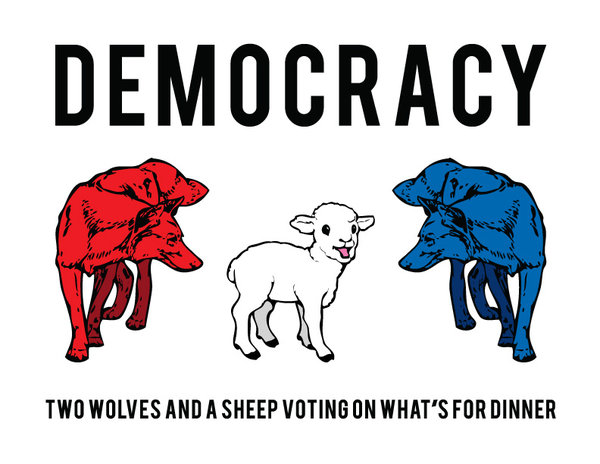
“Democracy is two wolves and a lamb voting on what to have for lunch.  Liberty is a well armed lamb contesting the vote.”      (attributed to) Ben Franklin

While attributions to Franklin may not quite be on the money since the term lunch did not enter into common parlance until the 1820s, the meat of this food for thought is still quite fulfilling.   It aptly captures the tyranny of the majority and class warfare epitomized by the ineptocracy currently in power.  To borrow a phrase from the unmasked Occupy Movement "This is what democracy looks like".

The coda of this faux Franklin phrase alludes to the Second Amendment, which protects Americans from tyranny.  It is important to recognize why the Second and the Fourth Amendments were included in the Bill of Rights.  The British tried to enforce burdensome laws on their British American colonies without any input by the citizenry.  When Americans balked at things like the Stamp Act and the Tea Act (1773), the powers that be doubled down on their policies by sending in massive force and forcing the colonists to quarter the Red Coats. Taxation without Representation is more than a slogan that DC Statehood activists have ironically re-appropriated.   The right to keep and bear arms was not about helping hunting but as natural rights which  are backstops against anarchy and organized tyranny to protect property rights.

Tuesday, March 20, 2012

DC as the District of Calamity--It's a State of Mind


These are the surreal musings of a  political animal living between the beltways.  My favorite contact sport may be politics but by interests are not poll driven. I think outside of the box and beyond the next spin cycle. And I will caucus with a variety of special interest groups. 
Some consider the Nation’s Capital as “Fantasyland on the Potomac”. Other outsiders are “Fed Up” with the Federal City.  Personally, a better state of mind is thinking of D.C. as “the District of Calamity” (sic).
A tongue in cheek encapsulation of this political weltanschauung was made in the preface of P.J. O’Rourke’s book “Parliament of Whores: A Lone Humorist Attempts to Explain the Entire US Government”(1991)—God is a Republican and Santa Claus is a Democrat.


God is an elderly, or at any rate, a middle-aged male, a stern fellow, patriarchal rather than paternal and a great believer in rules and regulations.  He holds men strictly accountable for their actions. He has little apparent concern for the material well being of the dis-advantaged. He is politically connected, socially powerful and holds the mortgage on literally everything in the world.  God is difficult. God is unsentimental. It is very hard to get into God’s country club. 
Santa Claus is another matter.  He’s cute. He’s non-threatening. He’s always cheerful. And he loves animals. He may know who’s been naughty and who’s been nice, but he never does anything about it. He gives everyone everything that they want without thought of a quid pro quo. He works hard for charities, and he’s famously generous for giving to the poor. 

Santa Claus is preferable to God in every way but one: there is no such thing as Santa Claus.
Knowing the prevalence of Cocktail Party elected officials, I would qualify this quip by substituting the GOP with conservatives.

Tuesday, January 10, 2012

DC Metro: More Fare Thee Well?


P.J. O’Rourke once observed “Giving money and power to the government is like giving whiskey and car keys to teen-aged boys”.  This demonstrated with the  latest proposal of fare increases for the Washington Area Transportation Authority.  The DC Metro Board has proposed another 5% fare increase to help alleviate budget shortfalls for the system.  This comes on top of the $109 million fare increases from July 2010 that included the dreaded 20 cent surcharge for peak-of-the-peak.

The Metro overloads believe that they will curry favor by lifting the peak of the peak fares, which they deemed a failure.  Instead, the gimmick would be to charge flat rates for Farecards--$6 for rush hour and $4 for other usage.  Alas, the changes would only bring in $66 million in new revenue so local governments would also need to increase their contributions by $53 million.  Hence the taxpayers get stuck once.

But the dirty secret which the Metro Board does not highlight in their proposal is Farecards tend to be a perk of working for the Federal government. So jacking up the rush hour Farecard toll to $6 throws the excess costs on Federal Agencies, which will inevitably be passed along to the nation's taxpayers.  Thanks Uncle Sugar, that means that taxpayers get stung a second time.

These fare increases frankly seem pretty steep, but they might not stink as much if the service was not so sketchy.  In June 2009, there was a fatal Fort Totten rear end train crash which killed eight passengers and one transit worker which was due to 'anemic safety culture'.   The blog "UnsuckDCMetro" chronicles the safety deficiencies in hardware as well as manpower.  Elevators are prone to be out of service.  Trains can be stuck for prolonged periods, occasionally requiring evacuations.

Despite the service shortcomings, the DC Metro has embarked on an $11 billion 23 mile expansion to Dulles International Airport.  Costs to local taxpayers were slated to escalating because the Washington Metro Airport Authority unilaterally decided that the metro station at Dulles should be buried so as not to interfere with the aesthetic of the Eero-Saarinen, which only adds another $330 million and an extra year to the expansion project. Fortunately, the WMAA flip flopped eschewing the burden on local taxpayers.  But this shows the dangers of bureaucrats behaving badly and  unaccountable public entities making uneconomic decisions with the burdens falling on taxpayers.

Raising fares without offering perceived benefits is financially dangerous.  The new Fyra High Speed Rail Service in the Netherlands between Amsterdam-Rotterdam and Breta cost Dutch taxpayers nearly $11 billion.  The Fyra does not offer marketedly better service and costs 20% more so consequentially those trains run 85% empty and run at about a half million dollar a day loss.

Urban planners and green enthusiasts have long touted the virtues of having railroads and subways to ease congestion and lessen the "environmental footprint".  Few of these modes of transport are profitable.  The reality is that most rail systems will be publicly operated boondoggles which enrich municipal union workers at the expense and convenience of the public.

H/T Nate Beeler, Washington Examiner

[This piece originally ran at DCBarroco.US]

Friday, November 11, 2011

Freedom Is Not Free: Commemorating Veterans Day


They tell me
'Freedom is never free.'
I know that-
More than most realize.
Freedom cost us more
Than we should have to give.
Freedom cost us blood.
It cost us the lives
Of our fathers,
Our sons,
Our brothers.
But while freedom is never free,
Remember-
It has been bought at great price,
And so is a thing of great value.
We must defend it,
From those who would take it away.
The defense of our freedoms
Will cost us-
More than we wish to pay.
But we must pay, to defend,
For if we try to make freedom free,
We forget-
True freedom is never free.

                              ~James Grengs


Numerologists may revel that  the calendar shows 11-11-11.   There is a similar significance in Armistice Day (also known as Remembrance Day), as it is traditionally celebrated  on eleventh hour of the eleventh day of the eleventh month, which marked the cessation of hostilities on the Western Front that ended the First World War in 1918.   Many Allied nations mark November 11th as a day to commemorate the fallen veterans who were amongst the estimated 60 million people who died  in the Great War.


The horror that Continental Europeans hold for the first major modern war is embodied in  "Le Monument aux  Morts" in Trévières, France by sculptor (and Mayor) Edmond de Laheudrie  (1921).  The sculpture is Nike, the Greek Goddess of Victory, which is also wearing the utility belt and helmet of the French version of Doughboys.   The original placement of "Le Monument aux Morts" is significant for two reasons, as  its position near the Church of St. Aignan links it to the bishop who defended Orleans from Attila the Hun in 451.  During the D-Day attacks from Allied Forces against Occupied France in World War II, a round of shrapnel struck the head of the sculpture which removed  its face below the upper lip along with most of its throat.  So all at once this statue represents both the the fleeting valor of  victory, the fragility of peace as well as the destructiveness of war.    This statue was cast in situ for placement at the D-Day Memorial in Bedford, Virginia.

President Franklin Roosevelt's Prayer on the eve of the D-Day Normandy Invasion  implores the Almighty for divine aid for our troops defending our freedom: "Lead them straight and true; give strength to their arms, stoutness to their hearts, steadfastness in their faith".


It is saddening to learn that the Obama Administration objects to the inclusion of this FDR radio prayer to being included in the World War II Memorial on the National Mall in Washington. Obama Bureau of Land Management Director Robert Abbey claims that inclusion of this prayer would "dilute" the central message of Memorial as well as violating the Commemorative Works Act. The real reason may be a politically correct attempt to erase any vestige of public religiosity which expressly alludes to Christianity.

The evolution of Armistice Day into Veterans Day was spearheaded by Alvin King, a cobbler from Emporia, Kansas in 1953 who campaigned to include all who served the nation as part of the November 11th commemoration. Within a year, Congress changed the holiday to Veterans Day. Alas, today people could claim this change was contrary to the spirit of the Commemorative Works Act.


Among the many memorials between the beltways, one of the standouts is the Korean War Memorial, which was dedicated by President George Herbert Walker Bush in 1992. The "central theme" of this Memorial is the polished marble reminder "Freedom is Not Free". The memorial recognizes the contributions and loss of troops by the 22 nations which comprised the United Nations forces during the hot war between 1950 and 1953 (N.B. there was an Armistice but never a Peace Treaty so technically there is still a state of war with North Korea). The Memorial includes a wall created by Louis Nelson that has photographs of 38 soldiers sandblasted into the granite (representing the disputed 38th parallel). The polished granite wall draws visitors into the memorial as they can not see the memorial to the troops without also seeing themselves and remembering that freedom is not free.


The hallmark of the Korean War Memorial is the squadron of 19 stainless steel soldiers (technically 14 US Army, 3 Marines, 1 Navy Corpsman and 1 Air Force Forward Air Observer) on patrol.   The sculptures by Frank Gaylord has also sparked some civil conflict.  The artist was so intent on protecting the intellectual property rights on his work that he sued the USPS for $775,000 for using the image on a first class stamp. Gaylord won all of his claims in Federal Court in 2010 save a fair use claim which is appealable to the US Supreme Court or US Court of Federal Claims.  So a tribute to the Veterans who epitomize the phrase "Freedom is Not Free"  must be a sketch of a snowy memory.


The rest of the Korean Memorial is a Pool of Remembrance, which bears the inscription
"Our nation honors her sons and daughters who answered the call to defend a country they never knew and a people they never met."

As Veterans return from the hot spots of Afghanistan, Iraq, Libya and Central Africa, we must  recall the wise words of President John F. Kennedy "As we express our gratitude, we must never forget that the highest appreciation is not to utter words, but to live by them." We should honor those in the armed forces who by their very service were on the front lines of defending liberty. But we must also remember that we are all called to defend the freedoms that we cherish.  


[This piece originally ran on 11/11/11 at DCBarroco.blogspot.com  but still rings true today]

Friday, February 25, 2011

DOTty about High Speed Rail


Florida Gov. Rick Scott (R-FL) rejected $2.4 Billion in Porkulus spending “High Speed” rail line in Central Florida.  There was not strong support from Central Florida citizens for this High Speed Rail project.  Voters in in Tampa and Polk County (FL) rejected a 1 cent sales tax increase dedicated to the “Supertrain”. Moreover, Gov. Scott reasoned that the Orlando metropolitan area (2 million) and the Tampa Metropolitan area (2.7 million) was too small to sustain the high speed rail system.  In addition, it is unlikely that the five scheduled stops in the 84 mile route would allow the train to ever reach “high speed” status.

Gov. Scott claimed that he was trying to protect Florida taxpayers from an estimated $3 Billion in cost overruns. The SunRail deal was structured so that Florida was responsible for half of the high speed rail costs and 20% of commuter rail costs.   Gov. Scott suggested “Rather than investing in a high-risk rail project we should be focusing on improving our ports, rail and highway infrastructure.”

Obama Secretary of Transportation Ray LaHood snarkily reacted that since there was an overwhelming demand for the stimulus funds earmarked for high speed rail and states like California ought to send a thank you to Florida for rejecting the funds.  LaHood denied that Florida taxpayers would be on the hook for cost overruns or stillborn project planning costs. This assertion is a stark contrast to the New Jersey paradigm, where the Obama Administration levied a charge back of $350 million to the Garden State when Gov. Chris Cristie (R-NJ) refused to write a blank check for the train to Macy’s.

House Transportation Committee Chairman Rep. John Mica (R-FL 7th) has been conflicted about rail expenditures.  Rep. Mica inveighed that “Amtrak's Soviet-style train system is not the way to provide modern and efficient passenger rail service." Mica also derided the Obama Administration’s push to spend an additional $53 Billion in passenger rail projects under the auspices of the Federal Rail Authority and Amtrak as “This is like giving Bernie Madoff another chance at handling your investment portfolio.”   But Mica was also disappointed that the SunRail point was scuttled by Gov. Scott, perhaps because a pet project of a Congressional Cardinal was being sacrificed.

Building upon the fact that Orlando attracts 63 million visitors a year, Rep. Mica renewed a call to complete 21 miles of the proposed SunRail route that would connect Orlando’s main airport with the Orlando Convention Center and Disney World. Based on the massive influx of tourists, this cautious first step on the Central Florida HSR route has a chance of not being a modal money pit.

However it is unlikely that the Obama Administration DOT Secretary LaHood will approve the project on its merits because it is not a high speed rail connecting two cities.  The real reason maybe somewhat murkier.  The Obama Administration was poised to point to SunRail during the President’s re-election effort as a validation of the $836 Billion in Stimulus Spending on shovel ready projects, as well as to burnish the 21st Century Infrastructure improvements and as a sop to green voters who want to force Americans out of their evil polluting automobiles. That argument is less auspicious when it is effectively a commuter rail for tourists.

It is probable that financial and power considerations also make Rep. Mica’s modest proposal less palatable to the Feds.  The State (or municipality) only needs to pick up 20% of commuter rail costs.  A commuter rail between MCO and Disney would be under the auspices of the City of Orlando and Orange County (FL), thus bypassing the authority of the Federal Rail Administration or Amtrak, which is a government sponsored enterprise that has long been a financial featherbed for connected Democrat politicos. No wonder why Between-the-Beltway elites are dotty about trains.

Florida is the fourth most populous state and does not receive anywhere near its fair share of federal transportation expenditures compared to its gas tax contributions to Washington.  It is unseemly to have unwanted federal public policy projects from outside of the state foisted on its citizenry who will bare the brunt of the boondoggle.

But local pet projects of politicians also can be undesirable.  In 1987, the Detroit People Mover was completed at the behest of longtime Detroit Mayor Coleman A. Young (D-Detroit) for a mere $187 million.  The 2.9 mile route does nothing to alleviate congestion or commuting.  It does attract 2.7 million in ridership, mainly because the $0.50 fares does not include the $3 per ride that the government absorbs.  It was a vanity project to take advantage of Federal transportation dollars.

If the U.S DOT diverts Florida’s transportation earmark from Florida to California, it will have the appearance of rewarding political friends and punishing foes to push an idealistic ambition.  Considering the estimated cost of $45 Billion for the Golden State High Speed Rail project and the possibility that cost overruns will skyrocket the cost to $60 Billion, they can use all of the earmarks that they can get.

H/T: Orlando Sentinel
H/T: Rick Geller

[This piece originally ran at DCBarroco.US]

Friday, February 11, 2011

TRAIN-ing Wheeling and Dealing


During a speech at Philadelphia’s 30th  Street Station, Vice President Joe Biden announced that the Obama Administration plans to spend $53 Billion over the next six years to upgrade and expand inter-city rail networks.  The Transportation Administration hopes that 80% of all Americans will have access to rail travel within 25 years.  These proposals keep Biden’s campaign promise that this would be the most train friendly administration ever.

The Porkulus legislation earmarked $8 billion in seed money to play with passenger trains and the FY 2010 budget included another $2.5 billion to railroad development.  But only $3.5 billion is going towards true high speed rail projects.  Instead The bulk of these funds have been directed to railroad projects in Central Florida and in California in order to have a ribbon cutting early in President Obama’s prospective second term.

Biden’s experience of taking over 7,900 round trips commuting on Amtrak between Capitol Hill and his home in Wilmington, Delaware apparently makes him an expert on railroads. Even though taxpayers take an estimated $50 loss on each Amtrak ticket sold, I doubt that many Americans who can not expense their quotidian commute to their Senatorial office can afford the $195 round trip on Acela or the $90 for the regional passenger service.

Either it is extraordinary forward vision or tunnel vision to keep touting the Supertrain. Amtrak only currently serves 78,000 passengers daily and has cost American taxpayers $35 billion since the government takeover in 1971.

The Orlando to Tampa leg of the Florida High Speed Rail System might be capable of traveling at 168 miles per hour.  But due to the number of stops along the 84 mile route, the “Supertrain” would only beat a car trip on a congested I-4 by a half an hour. This innovation comes at an estimated cost of $2.7 billion, but such government run infrastructure projects inevitably have severe cost overruns.  In two years, the cost estimates for California’s Bullet Trains have risen by a third to $43 billion.  For the High Speed Rail System which the Obama Department of Transportation envisions, it would cost $100 billion.  For true high speed trains, CNN estimates the cost of the system at $500 billion in 2009 dollars.


Train enthusiasts insist that investing in passenger rail improvements will alleviate road congestions.  Reason TV rightly points out that intercity passenger rail does nothing to alleviate rush hour traffic jams. And many of those metropolitan areas already have commuter rail services.  Based on overseas examples, these high speed rail projects are a money pit as only two bullet train projects have ever re-cooperated their infrastructure costs.

Naive observers may wonder why the Obama Administration seems almost as obsessed on trains as the Simpson’s Springfield was smitten with Monorails?  I believe that there is a sincere impetus to improve our nation’s intermodal infrastructure with a bias that a bigger government can do a better job.  But there is certainly some TRAIN-ing (sic) wheeling and dealing.  First off, to quote our National Treasure Joe Biden “[A]s Barack says, a three-letter word: jobs. J-O-B-S, jobs.”  Union jobs in particular. When these projects receive such massive federal funding, they will be obliged to follow federal rules, which have a strong bias towards hiring union workers.  After the ribbon cutting, who will need to staff the rails? Union workers of course.  Once the systems are operational, they will continue to require massive government subsidies. And unless we risk being paralyzed by a intercity rail strike, it is necessary to appease the rail unions.

There is the notion of political payoff.  When newly elected Governors John Kasich (R-OH) and Scott Walker(R-WI) decided to opt for a political train derailment of this high speed rail folly, the Obama Administration withdrew those allocated transportation funds with prejudice. When New Jersey Governor Chris Christie (R-NJ) opted not to proceed with the $9 billion Hudson train tunnel to Macy’s, the Federal government sued to get the planning seed money back.  Is it any coincidence that whenever Republican Governors try to derail the Obama Administration's obsession with trains on behalf of their constituents that these red states are figuratively thrown from the train and they lose the intermodal transportation funds that they richly deserve?

I fully appreciate House Transportation Committee Chairman John Mica (R-FL 7th) cynicism regarding the latest push to spend lots of money on a train folly.  Mica asserted that the Federal Railway Administration should not be giving grants or selecting projects.  Moreover, Mica recognized that Amtrak highjacked 72 of 78 projects, that were mostly costly and many had already been rejected by state agencies.  Mica inveighed that “Amtrak's Soviet-style train system is not the way to provide modern and efficient passenger rail service."  To make a point, Mica analogized this rail proposal as: “This is like giving Bernie Madoff another chance at handling your investment portfolio.”

Notwithstanding this skepticism of the merits of improving the intercity passenger rail system in intermodal transporation, the expensive earmark makes a mockery of President Obama’s State of the Union show, where he promised that there would be a five year across the board freeze on federal spending.

[This piece originally ran on DCBarroco.US]

Saturday, February 5, 2011

What the Hail?


Christina Aguilera’s performance of the National Anthem at Superbowl XLV was marred by a lyric malfunction. The pop star botched the ramparts verse and instead sang “What so proudly we watched at the twilight’s last gleaming”.  This echoed a prior line, which she also flubbed.  Aside from the lyrical miscued, Aguilera tried switching up the melodies a couple of time, to less successful effect than Whitney Houston at Superbowl XXV.

 Personally, I was watching in a boisterous space where viewers were more capable of witnessing how adeptly Aguilera’s wardrobe covered her tattoos. Our crowd cheered along with the crowd in Dallas when the video feed switched to our troops serving in Afghanistan.

If Simon Cowell was offering a critique, he would certainly say that a singer needs to know her lines, especially for a familiar short song that is to be sung before a billion people watching.  Such an analysis would be spot on.

 But at least Aguilera’s rendition was respectful, unlike Roseanne Barr’s 1990 San Diego Padre’s atrocity of an anthem.  It is a wonder that Keith Olbermann did not name Barr “the Worst Person in the World”.  But this was before and after Olbermann's stint on MessNBC.

But I suspect that Aguilera was quite nervous, as some of her prior renditions of the Star Spangled Banner at sporting events were outstanding.  And it seems that she was concentrated more on changing the melody than on the lyrics.  That is appropriate if one is “Listening Electively” in the early Presidential Primaries, but not so much when being a professional singer.

Lyrically, Francis Scott Key’s poetic magnus opus is poignant, but he conveniently set it to “To Anacreon in Heaven”, an English pub song used as a sobriety test. For me, the only more testing melodic line in America's songbook standard is the genius who set Happy Birthday to the children's song  "Good Morning to All" from 1893.

Even spirited and heart felt renditions of the National Anthem can cause controversy, as Jose Feliciano’s rendition during game 5 of the 1968 World Series in Detroit did, or Jimi Hendrix’s electric guitar version at Woodstock in 1969.

While cynics may chuck about Aguilera’s gaffe, what remains with me is how the crowd cheered for our soldiers on the front line in Afghanistan, as did the room where I was watching the spectacle. As I rewatched the video, I noticed the shot of Pittsburg Steelers Cornerback William Gay chocked up with emotion during the National Anthem.  At a time when American foreign policy is embarking on an agonizing reappraisal and the left savaged security commitments made during the last administration, it is heartening to know that people between the beltways and in the heartland honor those who risk their lives to protect our freedoms.